
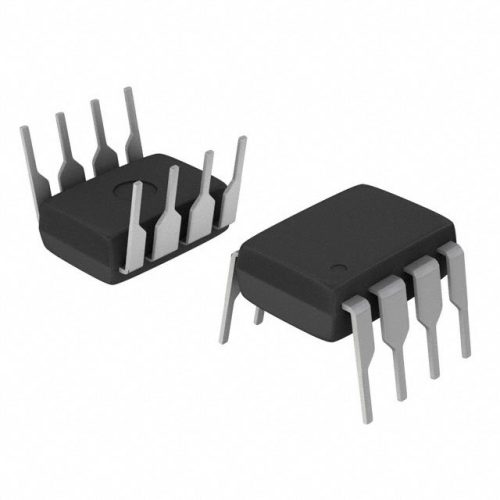

Overview: SN74LVC1G17 Schmitt-Trigger Buffer Gate
The SN74LVC1G17 by Texas Instruments is a single buffer gate featuring Schmitt-trigger input for high noise immunity and signal stability. It functions effectively over a wide voltage range of 1.65V to 5.5V, ensuring broad compatibility with modern logic devices.
This device is fabricated using advanced CMOS technology and is equipped with TTL/CMOS-compatible inputs. Its push-pull output configuration and high drive capability of ??32 mA make it suitable for various signal conditioning roles in compact electronic systems.
🔥 Best-Selling Products
Technical Features and Parameters
| Parameter | Min | Max | Unit |
|---|---|---|---|
| Supply Voltage (VCC) | 1.65 | 5.5 | V |
| High-Level Input Voltage (VIH) | 0.7 ?? VCC | ?C | V |
| Low-Level Input Voltage (VIL) | ?C | 0.3 ?? VCC | V |
| Output Drive Capability | ??32 | ?C | mA |
| Max Propagation Delay | ?C | 6.2 | ns |
| Package | SC-70-5 (DCK) | ?C | |
Why SN74LVC1G17 is Ideal for Noise-Immune Signal Buffering
Equipped with Schmitt-trigger input technology, the SN74LVC1G17 outperforms conventional buffers by providing hysteresis. This feature guarantees stable output signals even when inputs experience slow edges or noisy transitions. It is widely endorsed by engineers for its high noise margin and energy efficiency in embedded, industrial, and consumer electronics designs.
Its compatibility with both low-voltage and traditional 5V systems ensures seamless integration. Distributed by IC Manufacturer, this buffer gate continues to gain popularity in high-reliability, space-limited applications.
🌟 Featured Products
-

“Buy MAX9312ECJ+ Precision Voltage Comparator in DIP Package for Reliable Performance”
-
QCC-711-1-MQFN48C-TR-03-1 Bluetooth Audio SoC with MQFN48C Package

-

0339-671-TLM-E Model – High-Performance TLM-E Package for Enhanced Functionality

-
1-1415898-4 Connector Housing, Electrical Wire-to-Board, Receptacle, Packaged
Additional Electrical Characteristics
| Feature | Details |
|---|---|
| Function | Single Buffer Gate |
| Input Type | CMOS with Schmitt Trigger |
| Output Type | Push-Pull |
| Drive Strength | ??32 mA |
| Operating Temperature | ?C40??C to 125??C |
| ESD Protection | ??2000 V (HBM) |
| Input Compatibility | TTL and CMOS |
Typical Applications
- Level shifting and interfacing between mixed-voltage domains
- Noise filtering in control signal paths
- Signal regeneration and delay line isolation
- Driving light loads in mobile and portable systems
Frequently Asked Questions (FAQ)
What differentiates this buffer gate from standard non-Schmitt devices?
The Schmitt-trigger input improves signal integrity by providing defined threshold levels for high and low transitions, making it more resilient to noise.
Can this device support low-voltage microcontrollers?
Yes, its operating voltage range of 1.65V to 5.5V allows for direct interface with both 1.8V and 3.3V logic families, expanding its versatility.
📩 Contact Us
Is SN74LVC1G17 suitable for battery-powered applications?
Absolutely. Its low current consumption and small form factor are ideal for compact, energy-efficient designs such as wearables or portable control systems.
What are the practical use cases for this device in embedded systems?
It??s commonly used for debouncing, level shifting, and buffering signals to enhance system robustness, especially in noisy or mixed-signal environments.
Does it require external pull-up resistors?
Not typically, since the push-pull output is capable of driving high and low states directly, simplifying board design and reducing component count.