
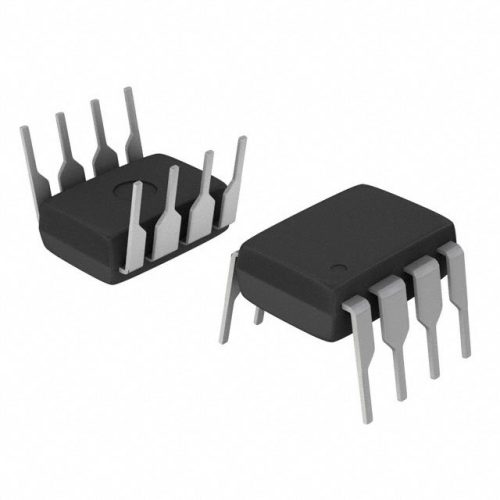

Overview: SN74LVC1G14 ?C High-Noise-Immunity Inverter With Schmitt Trigger
The SN74LVC1G14 by Texas Instruments is a single inverter gate featuring a Schmitt-trigger input. Designed for noise rejection and clean logic transitions, this CMOS logic device ensures reliable output even under fluctuating input signals. It supports a wide operating voltage from 1.65V to 5.5V, making it ideal for mixed-voltage systems.
Encased in a compact SC-70-5 (DCK) package, the device is optimized for size-critical designs and mobile platforms. It offers TTL and CMOS input compatibility and can deliver up to ??32 mA output drive, suitable for buffering and driving low-impedance loads.
🔥 Best-Selling Products
Technical Characteristics and Parameters
| Parameter | Min | Max | Unit |
|---|---|---|---|
| Supply Voltage (VCC) | 1.65 | 5.5 | V |
| Input Threshold ?C High (VIH) | 0.7 ?? VCC | ?C | V |
| Input Threshold ?C Low (VIL) | ?C | 0.3 ?? VCC | V |
| Output Drive | ??32 | ?C | mA |
| Propagation Delay (tpd) | ?C | 6.2 | ns |
| Package Type | SC-70-5 (DCK) | ?C | |
Performance Advantages Compared to Conventional Logic Inverters
Unlike standard inverter gates, the SN74LVC1G14 utilizes Schmitt-trigger technology to introduce hysteresis. This allows it to reject slowly changing or noisy signals more effectively. Its fast switching characteristics and high drive output are often praised by system designers in industrial and portable environments.
Its ultra-small SC-70-5 footprint reduces PCB area, making it a go-to component in dense IoT, sensor modules, and embedded systems. With wide voltage compatibility, it streamlines integration across diverse platforms. Trusted by engineers, this inverter is readily available from IC Manufacturer, your reliable partner for precision logic devices.
🌟 Featured Products
-

“Buy MAX9312ECJ+ Precision Voltage Comparator in DIP Package for Reliable Performance”
-
QCC-711-1-MQFN48C-TR-03-1 Bluetooth Audio SoC with MQFN48C Package

-

0339-671-TLM-E Model – High-Performance TLM-E Package for Enhanced Functionality

-
1-1415898-4 Connector Housing, Electrical Wire-to-Board, Receptacle, Packaged
Additional Electrical Features
| Feature | Specification |
|---|---|
| Function | Single Inverter Gate |
| Input Type | CMOS with Schmitt Trigger |
| Output Type | Push-Pull |
| Drive Strength | ??32 mA |
| Operating Temperature | ?C40??C to 125??C |
| ESD Protection | ??2000 V (HBM) |
| Input Compatibility | TTL/CMOS |
Typical Applications
- Signal conditioning for noisy switch inputs in consumer electronics
- Pulse shaping in sensor-driven industrial controls
- Digital debounce circuits for mechanical inputs
- Level shifting across logic domains in IoT gateways
Frequently Asked Questions (FAQ)
What does the Schmitt-trigger input offer over regular inverters?
It introduces hysteresis, allowing for noise immunity by requiring a specific threshold to switch states. This ensures clean, bounce-free transitions even in noisy environments.
Can SN74LVC1G14 interface with both 3.3V and 5V logic?
Yes. With an input voltage range from 1.65V to 5.5V, it can seamlessly integrate with a wide range of modern and legacy logic systems, including both 3.3V and 5V platforms.
📩 Contact Us
Is this component ideal for battery-powered systems?
Absolutely. Its low current operation, combined with compact packaging and robust signal control, makes it an excellent choice for low-power, portable, and mobile designs.
Does it support debounce logic for tactile switches?
Yes. Its built-in Schmitt-trigger function makes it ideal for implementing debounce logic, helping stabilize inputs from mechanical switches without additional components.
Are pull-up or pull-down resistors necessary with this device?
No external pull-up or pull-down resistors are typically required due to its internal configuration and strong push-pull output drive capability, reducing BOM complexity.
