
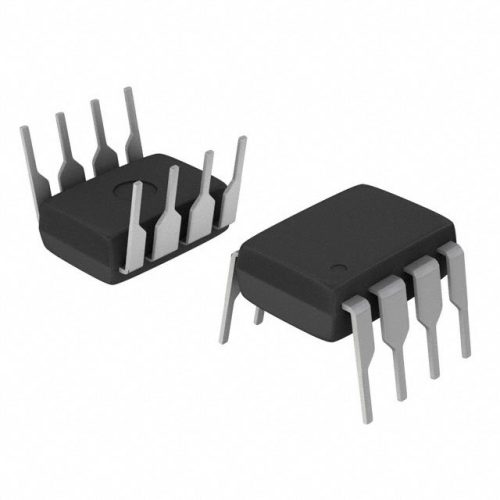

Overview: SN74LS47 BCD to 7-Segment Decoder for Common-Anode Displays
The SN74LS47 from Texas Instruments is a BCD (Binary-Coded Decimal) to seven-segment decoder/driver IC designed to control common-anode LED displays. With its open-collector outputs, it enables flexible interfacing with a variety of segment display modules. This device simplifies the logic required to convert 4-bit BCD input into corresponding numeric output on 7-segment displays.
Reliable and efficient, this IC is widely trusted for real-time numeric display solutions in systems that demand visibility and logic-level compatibility. Its TTL-compatible inputs make it easy to integrate into legacy and modern designs, while offering stable display performance in digital counters, voltmeters, and industrial equipment.
🔥 Best-Selling Products
Key Electrical Characteristics and Pin-Level Functions
| Parameter | Value | Unit |
|---|---|---|
| Function | BCD to 7-Segment Decoder/Driver | – |
| Package | DIP-16 | – |
| Output Configuration | Open-Collector | – |
| Input Type | TTL Compatible | – |
| Operating Voltage | 4.75 to 5.25 | V |
| Mounting Type | Through Hole | – |
| Supported Display | Common-Anode 7-Segment | – |
Advantages of SN74LS47 over Standard Decoder Chips
The SN74LS47 provides open-collector outputs capable of directly driving LED segments through external resistors, unlike standard CMOS decoders. This gives engineers more control over current-limiting configurations for precise brightness management. Its TTL logic level support ensures stable behavior even in noisy or electrically complex environments.
Featuring built-in blanking control and ripple-blanking features, it helps minimize ghosting and unnecessary power consumption. Furthermore, the DIP-16 package allows for easy integration in prototyping boards or production PCBs that prioritize through-hole reliability.
🌟 Featured Products
-

“Buy MAX9312ECJ+ Precision Voltage Comparator in DIP Package for Reliable Performance”
-
QCC-711-1-MQFN48C-TR-03-1 Bluetooth Audio SoC with MQFN48C Package

-

0339-671-TLM-E Model – High-Performance TLM-E Package for Enhanced Functionality

-
1-1415898-4 Connector Housing, Electrical Wire-to-Board, Receptacle, Packaged
Field-proven by automation engineers, control panel integrators, and embedded developers, the SN74LS47 is recommended for use in critical numeric readout interfaces. Order now from IC Manufacturer to ensure compatibility and performance in your next display-driven project.
Detailed Electrical and Functional Specifications
| Specification | Details |
|---|---|
| BCD Input | 4-bit |
| Output Type | Open-Collector |
| Logic Family | LS (Low Power Schottky) |
| Display Type | 7-Segment Common Anode |
| Ripple Blanking Input/Output | Yes |
| Blanking Input | Yes |
| Operating Temperature | 0??C to 70??C |
Typical Applications of the SN74LS47
- Industrial digital counters and voltmeters
- Consumer electronics with LED numeric indicators
- Time display in embedded system clocks
- Test and measurement devices requiring real-time numeric outputs
- Scoreboards and control consoles in public information systems
Frequently Asked Questions (FAQ)
What is the benefit of open-collector outputs in this device?
Open-collector outputs enable the designer to connect external resistors and power sources for driving displays, offering better flexibility in current control and segment illumination levels.
📩 Contact Us
Is the SN74LS47 compatible with CMOS logic levels?
No, this device is designed for TTL logic levels. Interfacing with CMOS requires level shifting or buffer circuitry to ensure compatibility and avoid logic misinterpretation.
Can I use SN74LS47 with common-cathode LED displays?
No. This IC is specifically intended for use with common-anode LED displays. Using it with common-cathode displays will result in incorrect or non-functional outputs.
How does ripple-blanking improve display quality?
Ripple-blanking minimizes leading and trailing zeroes in multi-digit displays and reduces unnecessary power consumption by turning off unused segments automatically.
What real-world applications can this device support?
Typical applications include voltmeters, frequency counters, lab instruments, and any embedded application that demands real-time, accurate numeric display on 7-segment LEDs.
