
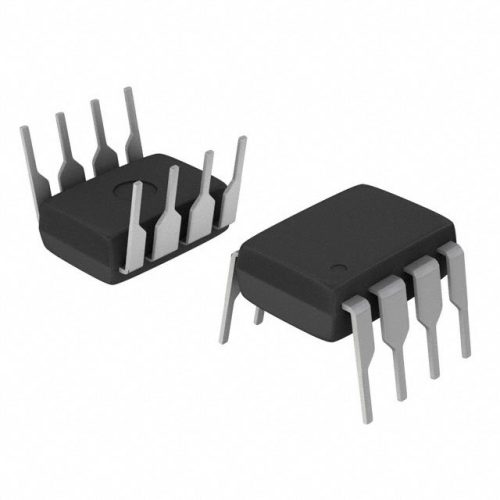

Overview: SN74HC74 Dual D-Type Flip-Flop with Preset and Clear
The SN74HC74 from Texas Instruments is a dual positive-edge-triggered D-type flip-flop featuring individual direct set and clear inputs. Designed for use in general-purpose storage registers, this CMOS logic IC provides reliable, synchronous data capture and asynchronous control. Its high-speed operation and minimal static power draw make it suitable for use in low-power and space-constrained digital logic systems.
Its versatility lies in enabling data synchronization and sequential logic operation across a wide range of embedded systems and timing-sensitive circuits.
🔥 Best-Selling Products
Key Electrical and Package Parameters
| Parameter | Value | Unit |
|---|---|---|
| Function | Dual D-Type Flip-Flop with Set/Reset | – |
| Package | SOIC-14 | – |
| Logic Type | CMOS | – |
| Trigger Edge | Positive | – |
| Set/Clear | Asynchronous | – |
| Pin Count | 14 | – |
| Mounting | SMD (Surface Mount) | – |
| Operating Voltage | 2V to 6V | V |
Why Engineers Prefer the SN74HC74
Compared to older TTL-based flip-flops, the SN74HC74 leverages CMOS technology for lower power usage and broader voltage compatibility. It supports independent set and clear operations, enabling flexible initialization and control.
Its dual flip-flop architecture in a single SOIC-14 package reduces BOM cost and PCB area, while still ensuring high-performance sequential logic. Engineering teams often endorse this component for clocked data latching, frequency division circuits, and timing-sensitive pulse generation.
🌟 Featured Products
-

“Buy MAX9312ECJ+ Precision Voltage Comparator in DIP Package for Reliable Performance”
-
QCC-711-1-MQFN48C-TR-03-1 Bluetooth Audio SoC with MQFN48C Package

-

0339-671-TLM-E Model – High-Performance TLM-E Package for Enhanced Functionality

-
1-1415898-4 Connector Housing, Electrical Wire-to-Board, Receptacle, Packaged
Backed by the reputation of IC Manufacturer, Texas Instruments devices like the SN74HC74 remain a go-to standard in precision logic design.
Detailed Technical Specifications
| Feature | Description |
|---|---|
| Logic Family | HC (High-Speed CMOS) |
| Function | Dual D Flip-Flop |
| Trigger Type | Positive Edge |
| Set/Clear Inputs | Asynchronous |
| Voltage Range | 2V to 6V |
| Output Current | ??5.2 mA at 4.5V |
| Propagation Delay | 18 ns max at 4.5V |
| Package | SOIC-14 |
| Temperature Range | -40??C to 85??C |
Typical Application Scenarios
- Pulse storage and logic timing circuits in automation
- Clock signal division and binary counting
- Debounce circuits in control systems
- Control latches in digital communication processors
- Memory elements in FSM (Finite State Machines)
Frequently Asked Questions (FAQ)
What kind of flip-flop configuration is implemented in SN74HC74?
It features two independent D-type flip-flops with asynchronous direct set and clear inputs, enabling controlled data storage and reset without requiring clock input.
📩 Contact Us
How does the SN74HC74 handle logic compatibility?
The device operates using CMOS logic levels, allowing it to be directly interfaced with microcontrollers and mixed-voltage digital circuits across various voltage domains.
Why is asynchronous control important in logic design?
Asynchronous set/reset capability allows immediate output control regardless of clock timing, which is critical for initializing or overriding outputs in timing-critical circuits.
Where is the SN74HC74 most effectively applied?
It is commonly used in applications such as pulse generation, binary counters, logic timing delay lines, and sequential logic implementations in automation and IoT systems.
What benefit does the SOIC-14 package provide?
The SOIC-14 format ensures compact integration onto SMT circuit boards, reducing space requirements while maintaining electrical performance and thermal dissipation.
