
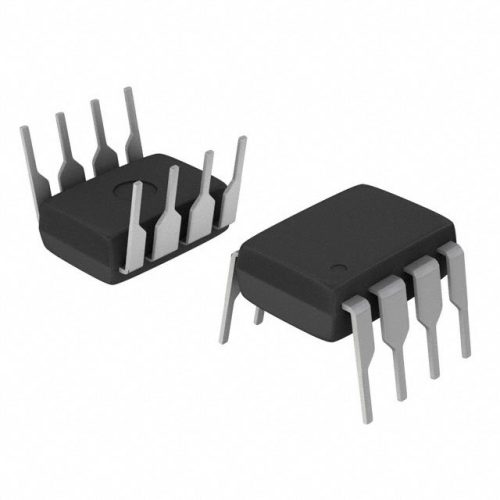

Overview: SN74HC4511 BCD to 7-Segment Decoder/Driver from Texas Instruments
The SN74HC4511 from Texas Instruments is a CMOS logic IC designed to convert Binary-Coded Decimal (BCD) inputs into signals for seven-segment LED displays. It supports display features such as lamp test, blanking control, and latch-enable to provide precise control over numeric indicators. With its high drive capability, it allows for direct interfacing with common-cathode LED displays while maintaining logic level compatibility with TTL and CMOS systems.
This decoder/driver is essential in embedded systems, instrumentation panels, and user interface subsystems, offering reliable numeric display performance in a compact DIP-16 package.
🔥 Best-Selling Products
Key Technical Specifications and Electrical Parameters
| Parameter | Value | Unit |
|---|---|---|
| Function | BCD to 7-Segment Decoder/Driver | – |
| Package | DIP-16 | – |
| Logic Family | HC | – |
| Input Voltage Range | 2 to 6 | V |
| Output Type | Standard CMOS | – |
| Logic Compatibility | TTL and CMOS | – |
| Mounting Type | Through Hole | – |
| Features | Lamp Test, Blanking, Latch Enable | – |
Advantages Over Other Decoder ICs
Compared to standard BCD decoders, the SN74HC4511 integrates several features that boost reliability and reduce system complexity. It includes a latch-enable function to store the input data, which ensures display stability during rapid BCD signal transitions. The integrated blanking input allows for easy power-saving and display shutdown capabilities without additional circuitry.
Its ability to work with both TTL and CMOS logic levels makes it a highly compatible choice for designers working across mixed-voltage systems. The DIP-16 package facilitates faster prototyping and ease of replacement in legacy systems.
🌟 Featured Products
-

“Buy MAX9312ECJ+ Precision Voltage Comparator in DIP Package for Reliable Performance”
-
QCC-711-1-MQFN48C-TR-03-1 Bluetooth Audio SoC with MQFN48C Package

-

0339-671-TLM-E Model – High-Performance TLM-E Package for Enhanced Functionality

-
1-1415898-4 Connector Housing, Electrical Wire-to-Board, Receptacle, Packaged
Electronics engineers consistently endorse this device for control panels, digital clocks, elevator displays, and test equipment, where **reliable segment decoding** and minimal external components are essential. Available from IC Manufacturer, the SN74HC4511 ensures dependable operation in critical numeric display applications.
Detailed Technical Specification Table
| Specification | Details |
|---|---|
| Logic Type | CMOS |
| Display Output | Seven-Segment Common Cathode |
| Input Format | BCD (4-bit) |
| Operating Voltage | 2V to 6V |
| Max Output Current | High current drive for LED segments |
| Latch Enable | Yes |
| Lamp Test | Yes |
| Blanking Input | Yes |
| Temperature Range | -40??C to 85??C |
Typical Applications
- Digital display modules in control systems
- Numeric counters and digital clocks
- Industrial instrumentation readouts
- Measurement systems with human-readable outputs
- Elevator and vending machine interfaces
Frequently Asked Questions (FAQ)
What type of LED display does the SN74HC4511 support?
This IC supports common-cathode seven-segment LED displays. It decodes BCD inputs and lights the correct segments to display numerals from 0 to 9.
📩 Contact Us
What is the purpose of the lamp test input?
The lamp test allows all segments of the display to be turned on simultaneously, making it useful for initial diagnostics, ensuring none of the LEDs are faulty or disconnected.
Can SN74HC4511 store data without an external register?
Yes. The built-in latch-enable pin lets the IC store input data and maintain display output, removing the need for an additional data latch circuit.
Is this device compatible with 3.3V systems?
Absolutely. With a voltage range of 2V to 6V, the SN74HC4511 works reliably in both 3.3V and 5V logic applications, making it highly adaptable.
Where is SN74HC4511 most commonly used?
It is extensively used in industrial control displays, digital measurement panels, and embedded systems that require direct numeric output via LED display modules.