
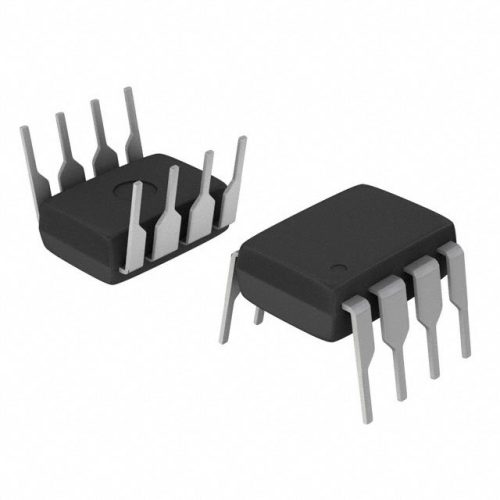

Texas Instruments SN74HC14 ?C Hex Inverter with Schmitt-Trigger Inputs
The SN74HC14 by IC Manufacturer is a high-speed CMOS logic IC featuring six independent inverters, each with a Schmitt-trigger input. Designed for digital applications requiring high noise immunity and clean signal transitions, it is particularly effective in noisy environments or with slowly changing input signals.
This device operates across a wide voltage range of 2V to 6V and features low static power consumption, making it ideal for modern low-power logic systems. Its hysteresis characteristic ensures that signals with slow rise and fall times are reliably converted into fast digital transitions.
🔥 Best-Selling Products
Key Electrical Characteristics and Specifications
| Parameter | Value | Unit |
|---|---|---|
| Logic Function | Hex Schmitt-Trigger Inverter | – |
| Number of Gates | 6 | – |
| Supply Voltage | 2 to 6 | V |
| Propagation Delay (at 5V) | 11 | ns |
| Input Hysteresis (typ) | 800 | mV |
| Operating Temperature | -40 to +85 | ??C |
| Package | SOIC-14 | – |
Performance Advantages and Application Benefits
- Noise Immunity: Schmitt-trigger inputs provide superior noise rejection and signal conditioning for unstable or noisy inputs.
- Fast Response: With a typical 11ns delay, SN74HC14 is suitable for high-speed digital processing systems.
- Low Power Design: High-speed CMOS technology ensures minimal power draw, critical for embedded and portable applications.
- Flexible Voltage Range: Supports wide Vcc levels for compatibility with 3.3V and 5V logic systems.
Typical Applications
- Signal conditioning for sensors with noisy outputs
- Switch debouncing and logic-level cleaning
- Waveform shaping in embedded logic circuits
- Triggering circuits and edge detectors
- Industrial automation signal processing
Frequently Asked Questions (FAQ)
What distinguishes the SN74HC14 from standard inverters?
The Schmitt-trigger inputs provide hysteresis, which means they require a higher voltage to switch high and a lower voltage to switch low, effectively filtering out noise and reducing false triggering.
Can SN74HC14 be used to debounce mechanical switches?
Yes. Its built-in hysteresis makes it an excellent choice for eliminating bounce from pushbuttons and switches, ensuring clean digital transitions.
🌟 Featured Products
-

“Buy MAX9312ECJ+ Precision Voltage Comparator in DIP Package for Reliable Performance”
-
QCC-711-1-MQFN48C-TR-03-1 Bluetooth Audio SoC with MQFN48C Package

-

0339-671-TLM-E Model – High-Performance TLM-E Package for Enhanced Functionality

-
1-1415898-4 Connector Housing, Electrical Wire-to-Board, Receptacle, Packaged
How does hysteresis benefit signal processing?
It adds a defined threshold gap, allowing input signals to stabilize before changing state, which is particularly useful for slowly transitioning or analog signals.
Is the SN74HC14 suitable for use with microcontrollers?
Absolutely. It supports standard CMOS logic levels and operates reliably at 3.3V or 5V, making it fully compatible with microcontrollers and embedded platforms.
📩 Contact Us
Are there alternative packages for compact designs?
Yes, SN74HC14 is available in multiple footprints, including SOIC-14 and TSSOP-14, allowing designers to choose based on board space and assembly preferences.
