
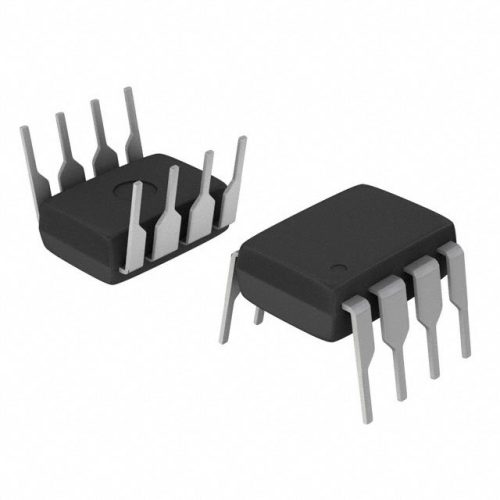

Overview: SN74HC132 Quad NAND Gate with Schmitt-Trigger Inputs
The SN74HC132 by Texas Instruments is a high-speed CMOS logic IC featuring four independent 2-input NAND gates, each with Schmitt-trigger inputs. It is designed to perform logical NAND operations while enhancing signal integrity through hysteresis characteristics. Engineers value this device for its stability in noisy environments and consistent performance across a range of voltages.
This product is particularly advantageous for edge detection, waveform shaping, and interfacing between analog and digital circuits. Compatible with TTL and CMOS logic levels, it provides robust signal conditioning in a compact DIP-14 package.
🔥 Best-Selling Products
Key Technical and Package Parameters
| Parameter | Value | Unit |
|---|---|---|
| Function | Quad 2-Input NAND with Schmitt-Trigger | – |
| Package | DIP-14 | – |
| Input Type | Schmitt Trigger | – |
| Logic Family | HC | – |
| Input Voltage | 2 to 6 | V |
| Output Type | CMOS | – |
| Pin Count | 14 | – |
| Mounting | Through Hole | – |
Benefits Compared to Standard Logic Devices
Standard NAND gates may fail to accurately interpret slow or noisy signals. The SN74HC132 solves this by integrating a Schmitt-trigger input configuration, which ensures cleaner transitions and greater noise immunity. This makes it especially useful in industrial automation and switching systems with unstable input levels.
The wide operating voltage range (2V to 6V) enables design flexibility across 3.3V and 5V logic systems, while its DIP-14 form factor suits prototyping and legacy equipment upgrades. The consistent rise and fall times across varying load conditions allow designers to rely on predictable behavior in edge-sensitive circuits.
🌟 Featured Products
-

“Buy MAX9312ECJ+ Precision Voltage Comparator in DIP Package for Reliable Performance”
-
QCC-711-1-MQFN48C-TR-03-1 Bluetooth Audio SoC with MQFN48C Package

-

0339-671-TLM-E Model – High-Performance TLM-E Package for Enhanced Functionality

-
1-1415898-4 Connector Housing, Electrical Wire-to-Board, Receptacle, Packaged
Recommended by circuit designers and engineers for critical timing and signal conditioning applications, the SN74HC132 is widely trusted across sectors including instrumentation, control systems, and communication interfaces. Now available from IC Manufacturer, this IC is a dependable option in digital design portfolios.
Detailed Technical Specifications
| Specification | Details |
|---|---|
| Logic Type | CMOS |
| Inputs per Gate | 2 |
| Number of Gates | 4 |
| Input Threshold | Schmitt Trigger |
| Operating Voltage | 2V to 6V |
| Output Drive | High current CMOS |
| Package | DIP-14 |
| Temperature Range | -40??C to 85??C |
Typical Applications
- Waveform shaping in digital and analog interface systems
- Edge detection in automation and robotics
- Level detection in analog-to-digital conversion stages
- Industrial control logic under noisy environments
- Oscillator circuits using Schmitt-based inverters
Frequently Asked Questions (FAQ)
What makes Schmitt-trigger inputs important in NAND gates?
Schmitt-trigger inputs provide hysteresis, which helps eliminate signal bouncing and noise in slowly changing or noisy input signals. This ensures clean digital transitions and better timing control.
📩 Contact Us
Can SN74HC132 be used in 3.3V logic systems?
Yes. The device operates from 2V to 6V, making it compatible with both 3.3V and 5V systems without requiring voltage translation.
How does this IC perform in noisy environments?
Thanks to its Schmitt-trigger design, it excels in noisy environments by rejecting minor fluctuations near logic thresholds, which standard logic gates might interpret as false transitions.
What advantages does DIP-14 packaging offer for design?
DIP-14 packaging is ideal for breadboard-based development and long-term stability in through-hole PCB assemblies, especially in industrial and repair scenarios.
Where is SN74HC132 typically implemented in real-world systems?
Common in sensor signal processing, edge detection logic, waveform generation circuits, and analog-to-digital conversion stages where clean transition detection is essential.
