
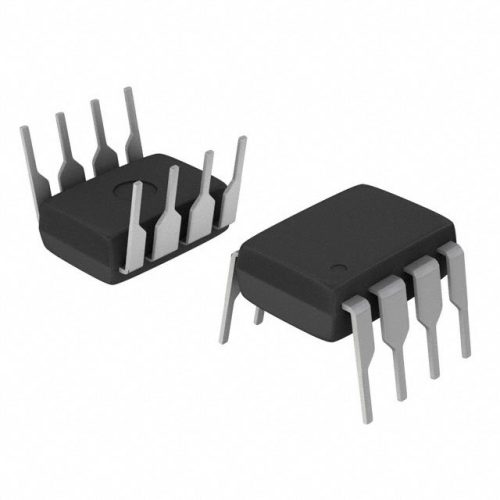

Overview: SN74HC123 Dual Retriggerable Monostable Multivibrator
The SN74HC123 is a dual retriggerable monostable multivibrator IC developed by Texas Instruments. Designed to offer precision pulse timing, this component is a staple in applications requiring controlled pulse width generation and timing delay adjustments. It features two independent monostable multivibrators in a single package, each with its own clear and trigger inputs, which enables synchronized timing sequences.
Whether used in frequency detection, signal processing, or delay generation circuits, the SN74HC123 stands out with its CMOS logic compatibility, robust input tolerance, and glitch-free output performance. Professionals across the industry rely on this IC for its proven reliability and straightforward integration in timing-critical designs.
🔥 Best-Selling Products
Key Specifications and Electrical Parameters
| Parameter | Value | Unit |
|---|---|---|
| Function | Dual Monostable Multivibrator | – |
| Supply Voltage (Vcc) | 2 to 6 | V |
| High-Level Input Current (Iih) | ??1 | ??A |
| Output Drive Capability | ??4 | mA |
| Typical tW Output Pulse Width | 100 | ns (at Vcc=5V) |
| Package | DIP-16 | – |
| Logic Type | CMOS, TTL Compatible | – |
Why Engineers Prefer SN74HC123 Over Generic Timing ICs
Unlike traditional one-shot timing ICs, the SN74HC123 features retriggerable pulse generation, meaning it extends the pulse width with successive triggers. This is essential for applications where signal duration varies based on environmental inputs.
Its dual independent channel configuration eliminates the need for multiple components in dual-delay systems, reducing PCB space and cost. Combined with CMOS technology, it delivers energy-efficient performance, outperforming older TTL-only devices in both stability and power savings.
🌟 Featured Products
-

“Buy MAX9312ECJ+ Precision Voltage Comparator in DIP Package for Reliable Performance”
-
QCC-711-1-MQFN48C-TR-03-1 Bluetooth Audio SoC with MQFN48C Package

-

0339-671-TLM-E Model – High-Performance TLM-E Package for Enhanced Functionality

-
1-1415898-4 Connector Housing, Electrical Wire-to-Board, Receptacle, Packaged
With its compact DIP-16 footprint, it is the preferred choice among designers aiming for ease of integration and robust functionality, as highlighted in multiple design reviews from seasoned engineers using components from IC Manufacturer.
Complete Electrical Characteristics Table
| Specification | Details |
|---|---|
| Pulse Width Control | Resistor-Capacitor (RC) Input Control |
| Trigger Modes | Rising Edge or Falling Edge Configurable |
| Output Type | Non-Inverting CMOS |
| Output State | Stable Low / High State |
| Operating Temp | -40??C to +85??C |
| Propagation Delay | Typical 30 ns |
Typical Use Cases and Applications
- Precision Pulse Generation for Industrial Control Systems
- Edge Detection and Delay Circuits in Signal Processing
- Timeout and Watchdog Timer in Embedded Controllers
- Pulse Width Shaping in Audio and Sensor Devices
- Glitch-Free Reset Control in Microcontroller Boards
Frequently Asked Questions (FAQ)
What is the core function of the SN74HC123?
It generates a stable pulse of predetermined width in response to a triggering signal. This is useful in timing and control circuits requiring single or repeated timing signals.
📩 Contact Us
Can the SN74HC123 be used with both TTL and CMOS logic?
Yes. The input and output logic levels are compatible with both CMOS and TTL logic families, which improves its flexibility in mixed-signal environments.
How do you control the timing duration?
The output pulse width is set using external resistor-capacitor (RC) timing components. By adjusting these values, users can fine-tune the duration to meet specific timing needs.
Is this IC power efficient for portable systems?
Absolutely. Built using high-speed CMOS technology, it offers low power consumption while maintaining high-speed operation, making it ideal for battery-operated systems.
What makes this IC suitable for industrial automation?
Its dual-channel timing configuration, retriggerable capability, and wide voltage range make it highly dependable in demanding control logic environments found in industrial automation systems.