


What Is Slew Rate and Why It Matters
In electronics, speed is not just about frequency.
A circuit can claim wide bandwidth and still fail when signals move too fast.
That failure has a name: slew rate limitation.
Slew rate is one of the most misunderstood—but most damaging—specifications in analog design. It quietly degrades accuracy, creates distortion, and limits real-world performance. Worse, it often goes unnoticed until late-stage testing.
This guide explains what slew rate is, why it matters, and how to design with it correctly—using clear language, real examples, and practical rules.
What Is Slew Rate?
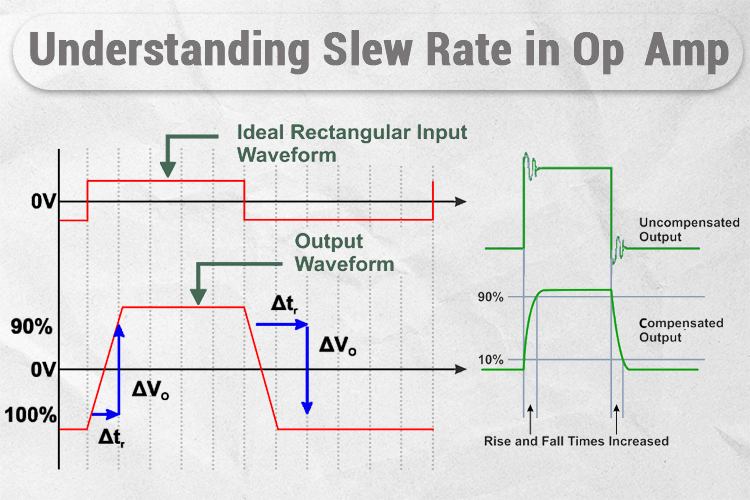
Slew rate describes how fast a circuit’s output voltage can change over time.
It answers a simple question:
How quickly can the output move when the input suddenly changes?
Formal definition
Slew rate is the maximum rate of change of output voltage, usually specified in volts per microsecond (V/µs).
Simple explanation
Imagine steering a car:
- Bandwidth is how fast the engine can spin.
- Slew rate is how quickly you can turn the steering wheel.
If the road bends sharply and you turn too slowly, you miss the curve—even with a powerful engine.
That’s exactly what happens in electronics.
Slew Rate as a Large-Signal Limitation
Slew rate is a large-signal effect. That makes it dangerous.
Large-signal vs. small-signal behavior

- Small signals: The circuit behaves linearly. Specs look great.
- Large signals: Internal limits kick in. The output slows down.
This is why a datasheet can promise:
- High bandwidth
- Low distortion
…and still fail in real applications.
Why bandwidth specs can mislead
Bandwidth tells you how fast small signals oscillate.
Slew rate tells you how fast large signals move.
They are not the same.
Slew rate vs. rise time
| Parameter | What it limits | Applies to |
|---|---|---|
| Bandwidth | Frequency response | Small signals |
| Rise time | Step response speed | Linear region |
| Slew rate | Max voltage change speed | Large signals |
Once slew rate is exceeded, linear models collapse.
Slew Rate in Operational Amplifiers
Op-amps are where slew rate matters most.
Why slew rate limits op-amps
Internally, op-amps rely on finite currents charging capacitors.
Current is limited. Capacitors resist fast voltage changes.
Physics wins.
Internal causes of slew rate limitation
- Compensation capacitors
Used to keep the amplifier stable. - Bias currents and current mirrors
These cap how fast internal nodes can move.
The result: a hard speed limit.
Typical slew rate ranges
| Op-amp type | Typical slew rate |
|---|---|
| General-purpose | 0.5 – 5 V/µs |
| Precision, low-noise | 1 – 20 V/µs |
| High-speed | 100 – 10,000+ V/µs |
Higher speed usually costs power, noise, and stability margin.
How Slew Rate Works in Real Circuits
Voltage change over time
Slew rate defines the steepest slope an output can produce.
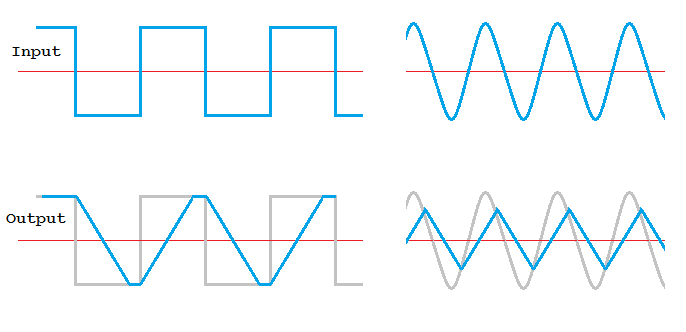
If the input demands more than that slope:
- The output falls behind
- The waveform distorts
What happens when a circuit can’t keep up
Instead of following the input:
- Square waves become triangles
- Sine waves flatten at the peaks
- Pulses smear and lose timing accuracy
This distortion is not subtle.
Visualizing slew rate limitation
On an oscilloscope, look for:
- Straight-line ramps instead of curves
- Identical rising and falling slopes
- Output lag that increases with amplitude
These are classic signs of slew limiting.
Why Slew Rate Directly Impacts Signal Accuracy
Slew rate doesn’t just slow signals.
It changes their shape.
Distortion by waveform type
| Signal | Effect of insufficient slew rate |
|---|---|
| Sine wave | Harmonic distortion |
| Square wave | Sloped edges, lost harmonics |
| Pulse | Timing errors, jitter |
Slew-rate limiting vs. clipping
- Clipping: Voltage limit
- Slew limiting: Speed limit
Slew-induced distortion (SID) occurs before clipping.
Why SID is dangerous
SID:
- Produces non-harmonic distortion
- Is difficult to filter
- Sounds harsh in audio systems
As Matti Otala famously warned in audio design:
“Transient distortion is more audible than steady-state distortion.”
Common symptoms
- Loss of detail
- Harshness or grain in audio
- Eye diagram closure in data systems
Slew Rate and High-Frequency Performance
High frequency and large amplitude are a dangerous mix.
The key relationship
The required slew rate is:
[
\text{Slew Rate} \ge 2\pi f V_{peak}
]
What this means
- Higher frequency → higher required slew rate
- Larger voltage swing → higher required slew rate
Example
A 10 V peak sine wave at 100 kHz requires:
[
2\pi × 100k × 10 ≈ 6.3\ \text{V/µs}
]
No margin. No safety.
Why bandwidth alone fails
A circuit may pass 100 kHz signals—
…but not at full amplitude.
That’s where designs break.
Slew Rate vs. Bandwidth: The Common Trap
Designers often over-trust bandwidth.
What bandwidth actually tells you
Bandwidth defines frequency response at small amplitudes.
It assumes:
- Linear operation
- No internal limits
Slew rate breaks those assumptions.
High bandwidth, low slew rate scenarios
- Precision op-amps
- Low-power amplifiers
- Heavily compensated designs
They look fast—until they’re not.
Aligning slew rate and bandwidth
Best practice:
- Calculate required slew rate first
- Choose bandwidth with margin
- Validate with large-signal simulation
Speed must be earned, not assumed.
Measuring Slew Rate in Practice
Bench measurement basics
- Apply a fast step input
- Measure output slope (ΔV / Δt)
Test signal options
| Method | Strength | Risk |
|---|---|---|
| Step input | Clear slew region | Input overshoot |
| Sine wave | Realistic | Needs math |
Identifying slew-rate distortion
On the scope:
- Flat, linear ramps
- Identical slopes regardless of input shape
- Increasing delay at higher amplitudes
Common mistakes
- Probe loading errors
- Limited input drive speed
- Misinterpreting bandwidth roll-off
Measurement discipline matters.
Practical Takeaways for Engineers and Buyers
How to read datasheets
- Check both slew rate and bandwidth
- Look for test conditions
- Note supply voltage and load
Avoid over- and under-spec
| Risk | Result |
|---|---|
| Under-spec | Distortion, redesign |
| Over-spec | Noise, power waste |
Smart selection rules
- Add 2–5× slew rate margin
- Validate with full-scale signals
- Test early, not late
Slew rate is not a luxury spec.
It is a design boundary.
Final Thought
Bandwidth tells you what frequencies pass.
Slew rate tells you whether reality keeps up.
Ignore slew rate—and your signals will betray you.
Respect it—and your designs will stay honest, clean, and reliable.
Speed, after all, is not about how fast you can go.
It’s about how fast you can change direction.
