

What Is LM7805 Used For?
Introduction to the LM7805 Voltage Regulator
The LM7805 is one of the most recognized electronic components in the world. Simple in form, yet powerful in function, it solves a problem that every electronic system faces: how to deliver a clean, stable 5-volt power supply. From student projects to industrial control boards, the LM7805 has earned its place as a trusted workhorse.
In an age dominated by high-efficiency switching regulators, the LM7805 still survives—and thrives. Why? Because simplicity, reliability, and predictability never go out of style.
What the LM7805 Is and Why It Matters
At its core, the LM7805 is a fixed 5V linear voltage regulator from the classic 78xx family. Feed it a higher DC voltage, and it delivers a steady 5 volts at the output—no programming, no configuration, no digital control.
Why it matters:
- Most digital electronics operate at 5V
- Power sources are often noisy or higher than required
- Sensitive logic circuits demand voltage stability
A well-known engineering proverb applies perfectly here:
“The simplest solution is often the most reliable.” — Engineering Design Principle
That is the LM7805 philosophy in a single sentence.
What Is LM7805 Used For? (Core Use Cases)
The LM7805 is used wherever stable 5V DC power is required and efficiency is not the primary concern.
Primary Uses
- Providing a regulated 5V supply from 7–35V DC inputs
- Power conditioning for logic ICs and microcontrollers
- Linear post-regulation after switching power supplies
- Educational and prototyping circuits
Typical Input-to-Output Role
| Input Voltage | Output Voltage | Use Case |
|---|---|---|
| 9V | 5V | Battery-powered logic circuits |
| 12V | 5V | Automotive or adapter-based systems |
| 24V | 5V | Industrial control electronics |
In short, LM7805 acts as a voltage “gatekeeper”, ensuring downstream circuits always see a safe and predictable voltage.
How the LM7805 Works
Understanding how the LM7805 works builds trust in its behavior.
Basic Working Principle
The LM7805 is a linear regulator. It does not switch. Instead, it:
- Compares output voltage with an internal reference
- Adjusts internal resistance
- Burns excess voltage as heat
Key Internal Functional Blocks
| Block | Function |
|---|---|
| Reference Voltage | Sets precise 5V target |
| Error Amplifier | Detects output deviations |
| Pass Transistor | Controls current flow |
| Feedback Network | Maintains regulation |
This closed-loop control ensures excellent line regulation (input changes) and load regulation (current changes).

Key Features and Electrical Specifications
The LM7805 gained popularity because its specifications are “good enough” for most real-world needs.
Electrical Highlights
- Output Voltage: 5V ±4%
- Input Voltage Range: 7V to 35V
- Output Current: Up to 1A (with heatsink)
- Dropout Voltage: ~2V
Built-in Protection Features
- Thermal shutdown
- Short-circuit protection
- Safe operating area (SOA) limiting
These protections make the LM7805 nearly foolproof, especially for beginners.
Typical Applications of the LM7805
The LM7805 appears in countless designs, both old and new.
Common Applications
- Powering microcontrollers (Arduino, 8051, PIC)
- Embedded control boards
- Consumer electronics
- Lab power supplies
- Breadboards and development kits
Application Snapshot
| Application | Why LM7805 Works Well |
|---|---|
| Educational circuits | Simple, visible operation |
| Prototyping | Minimal components |
| Post-regulation | Reduces ripple and noise |
| Fixed 5V rails | No configuration needed |
Its predictability makes it a favorite in classrooms and labs worldwide.
Advantages of Using the LM7805
Despite its age, the LM7805 delivers several timeless advantages.
Key Benefits
- Extreme simplicity – two capacitors and done
- Low output noise compared to switch-mode regulators
- High reliability over decades of use
- Low cost and wide availability
As one electronics proverb states:
“If it isn’t broken, don’t optimize it.”
For low-power 5V rails, the LM7805 simply works.
Limitations and Design Considerations
The LM7805 is not perfect. Understanding its limits prevents failure.
Power Dissipation
Linear regulators waste power as heat.
Power Loss Formula:
P = (Vin − 5V) × Iout
| Example | Result |
|---|---|
| 12V → 5V at 0.5A | 3.5W (very hot) |
| 9V → 5V at 0.2A | 0.8W (manageable) |
Design Warnings
- Requires heatsink at higher currents
- Inefficient for battery-powered systems
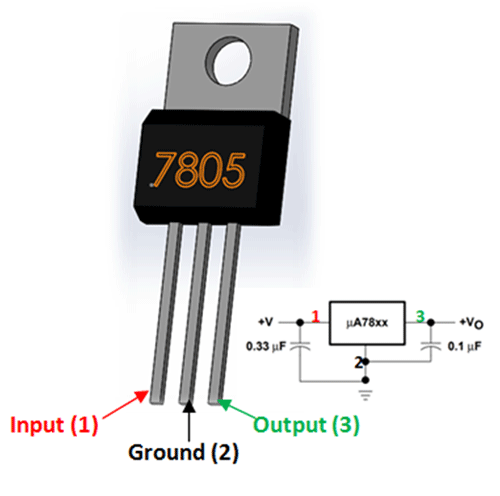
- Needs proper input/output capacitors
- No reverse polarity protection
If efficiency matters, this is not your part.
LM7805 vs Other Voltage Regulators
Choosing the right regulator depends on context.
Comparison Overview
| Feature | LM7805 | LM317 | Buck Converter |
|---|---|---|---|
| Output | Fixed 5V | Adjustable | Adjustable |
| Efficiency | Low | Low | High |
| Noise | Very Low | Low | Higher |
| Complexity | Very Simple | Simple | Complex |
When LM7805 Wins
- Fixed 5V requirement
- Low to moderate current
- Noise-sensitive circuits
- Fast design turnaround
When It Loses
- Battery-powered systems
- High-current loads
- Large input-to-output voltage gaps
When Should You Choose LM7805?
Use the LM7805 when clarity beats cleverness.
Ideal Scenarios
- Educational and learning projects
- Bench-top power supplies
- Post-regulation for cleaner rails
- Low-cost embedded designs
Decision Checklist
- Do you need exactly 5V?
- Is current under 500mA?
- Is heat manageable?
- Is simplicity a priority?
If most answers are “yes,” the LM7805 is a solid choice.

Summary: Is LM7805 the Right Choice for Your Project?
The LM7805 is not modern.
It is not efficient.
It is not flashy.
But it is reliable, predictable, and timeless.
Key Takeaways
- LM7805 provides stable 5V from higher DC inputs
- Best for low-to-moderate current applications
- Excellent for education, prototyping, and noise-sensitive designs
- Poor choice for high-efficiency or battery-powered systems
Practical Recommendation
Choose the LM7805 when you want certainty instead of complexity. In many designs, that confidence is worth far more than a few lost watts.
In electronics, as in engineering life:
“Trust the proven solution—especially when failure is not an option.”
