

What Is a Flyback Converter IC?
Power electronics hides in plain sight. Every charger. Every adapter. Every small power rail. Behind many of them sits one quiet workhorse: the flyback converter IC.
Simple in structure. Surprisingly deep in design trade-offs. Massively important for cost, safety, and scalability.
This guide explains what a flyback converter IC is, how it works, and how to choose the right one—from an engineering, product, and sourcing perspective. Clear language. Real-world focus. No fluff.
Understanding the Basics of a Flyback Converter IC
A flyback converter IC is an integrated control chip that manages a flyback power supply. It controls switching, regulation, protection, and often startup and fault handling.
At its core, it converts power from one voltage level to another. Often AC to DC. Often isolated. Often low-to-medium power.
Why does it matter?
Because flyback ICs sit at the intersection of cost, safety, efficiency, and compliance. Choose well, and your product scales smoothly. Choose poorly, and problems surface late—thermal failures, EMI issues, certification delays.
Common applications include:
- Phone and laptop chargers
- Wall adapters and power bricks
- Industrial auxiliary supplies
- Embedded system housekeeping rails
In sourcing terms, flyback ICs are strategic parts. They define transformer design, EMI behavior, and even PCB layout.
As the old engineering proverb goes: “The power supply is the product you don’t see—until it fails.”
How a Flyback Converter IC Works


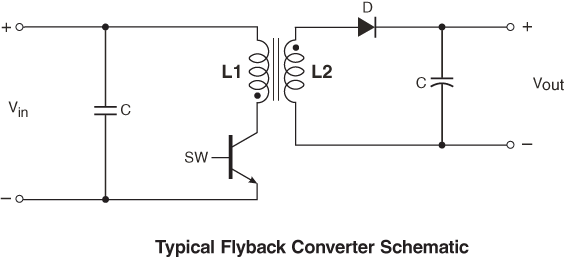
The flyback converter is not a transformer in the traditional sense. It is closer to a coupled inductor.
Here’s the simplified flow:
1. Switch ON phase
The IC turns on a MOSFET. Current ramps up in the transformer’s primary winding. Energy is stored in the magnetic field.
2. Switch OFF phase
The MOSFET turns off. The stored energy transfers to the secondary winding. Current flows through a rectifier into the output capacitor and load.
3. Regulation and feedback
The IC monitors output voltage (directly or indirectly). It adjusts duty cycle or frequency to keep output stable.
Unlike forward or buck converters, energy storage and transfer happen at different times. This gives flyback converters their flexibility—and their quirks.
Isolated vs Non-Isolated Flyback Converter ICs
Isolation changes everything.
Isolation means there is no direct electrical connection between input and output. The transformer provides safety separation.
Isolated flyback ICs
- Used in offline AC-DC supplies
- Required for user safety
- Meet UL, IEC, and EN standards
- Common in chargers and adapters
Non-isolated flyback ICs
- Used when safety isolation is not required
- Smaller and cheaper
- Often used inside already-isolated systems
Isolation impacts:
- Transformer design
- PCB creepage and clearance
- EMI behavior
- Certification cost
For offline products, isolation is rarely optional. It is driven by regulation, not preference.
Primary-Side vs Secondary-Side Regulation


How does the IC know the output voltage?
Two main methods dominate.
Primary-Side Regulation (PSR)
- Senses reflected voltage on the primary
- No optocoupler required
- Lower cost and higher reliability
- Less accurate under load changes
Secondary-Side Regulation (SSR)
- Uses optocoupler and reference
- Higher accuracy
- Better load and line regulation
- More components and aging risk
Trade-off summary:
| Aspect | PSR | SSR |
|---|---|---|
| Accuracy | Medium | High |
| Cost | Lower | Higher |
| BOM size | Small | Larger |
| Long-term drift | Low | Opto aging risk |
For consumer chargers, PSR dominates. For industrial and precision rails, SSR still rules.
Key Functions Integrated Inside a Flyback Converter IC
Modern flyback ICs are far more than switches.
Core control methods include:
- PWM (fixed frequency)
- Quasi-resonant (valley switching)
- Frequency modulation
Conduction modes matter:
- DCM (discontinuous): simple, noisy
- CCM (continuous): efficient, complex
- BCM/CrCM: balance of both
Protection is non-negotiable:
- Over-current protection (OCP)
- Over-voltage protection (OVP)
- Over-temperature protection (OTP)
- Short-circuit protection (SCP)
Efficiency features add polish:
- Soft-start
- Burst mode at light load
- Standby power reduction
These features directly affect EMI, efficiency, and field reliability.
Internal vs External MOSFET Flyback ICs
One decision shapes everything: Is the MOSFET inside the IC or external?
Integrated MOSFET ICs
- Lower BOM
- Faster design cycle
- Limited power and thermal headroom
External MOSFET controllers
- Higher power capability
- Better thermal distribution
- More flexibility in sourcing
| Factor | Integrated | External |
|---|---|---|
| Design speed | Fast | Slower |
| Max power | Lower | Higher |
| Cost at low power | Lower | Higher |
| Scalability | Limited | Strong |
For adapters under ~65W, integration wins. Beyond that, external MOSFETs often make sense.
Flyback Transformer Design Considerations


The transformer is the heart—and the most common failure point.
Key parameters:
- Turns ratio sets voltage
- Magnetizing inductance sets current slope
- Leakage inductance drives spikes and EMI
Design pitfalls to avoid:
- Poor coupling → high leakage → snubber losses
- Inadequate creepage → safety failure
- Wrong core size → saturation or inefficiency
Transformer design is where electrical, thermal, and safety rules collide. This is why reference designs matter.
EMI, Compliance, and When Flyback Is the Wrong Choice
Flyback converters are efficient—but noisy.
Common EMI sources:
- Drain voltage ringing
- Fast di/dt loops
- Transformer leakage
Mitigation strategies:
- Tight layout
- RC or RCD snubbers
- Common-mode chokes
- Frequency jitter
Despite best efforts, flyback has limits.
Flyback is not ideal when:
- Power exceeds ~150W
- Ultra-low EMI is required
- Very high efficiency is mandatory
At that point, designers move to forward, LLC, or resonant topologies.
How to Select the Right Flyback Converter IC
Selection is not about the datasheet headline. It is about fit.
Ask these questions:
- Input voltage range?
- Required isolation level?
- Output accuracy target?
- Standby power limits?
- EMI margin and certification plan?
Then consider supply chain reality:
- Second-source availability
- Lifecycle guarantees
- Package standardization
A flyback IC is not just a component. It is a design commitment.
Final Thoughts
Flyback converter ICs dominate low-to-mid power conversion for a reason. They are flexible. Cost-effective. Proven.
But they reward understanding—and punish shortcuts.
Design them with respect. Source them with strategy. And remember:
“Power supplies don’t sell products—but they can sink them.”
If you want, I can:
- Recommend IC selection criteria by power range
- Compare flyback vs buck for your application
- Help structure a sourcing or second-source strategy
Just say the word.
