

Power Dissipation in Small Form Factor Packages
Power is invisible. Heat is not.
In small form factor (SFF) packages, that difference defines success or failure. As electronics shrink, power dissipation becomes the silent limiter of performance, reliability, and product life. Ignore it, and even the most elegant design can fail in the field.
This article delivers expert-level yet readable guidance on power dissipation in SFF packages—focused on depth, real-world design trade-offs, and search intent. Only the 8 most critical topics are included, each explained clearly and practically.

Understanding Power Dissipation in Small Form Factor (SFF) Packages
Power dissipation is not power consumption.
Power consumption is what a device draws. Power dissipation is what turns into heat inside the package. That heat must escape. If it doesn’t, temperature rises. Quickly.
As packages shrink, three things happen at once:
- Less surface area to release heat
- Shorter thermal paths that saturate faster
- Higher power density from advanced silicon nodes
This is why small packages run hotter at the same wattage. A 1 W device in a large QFP may survive comfortably. The same 1 W in a WLCSP can exceed limits in seconds.
Poor thermal control leads to:
- Reduced performance (thermal throttling)
- Parametric drift and timing errors
- Long-term reliability loss
- Costly field failures and recalls
As the proverb attributed to engineering culture goes:
“Heat doesn’t disappear. It only moves—or destroys.”
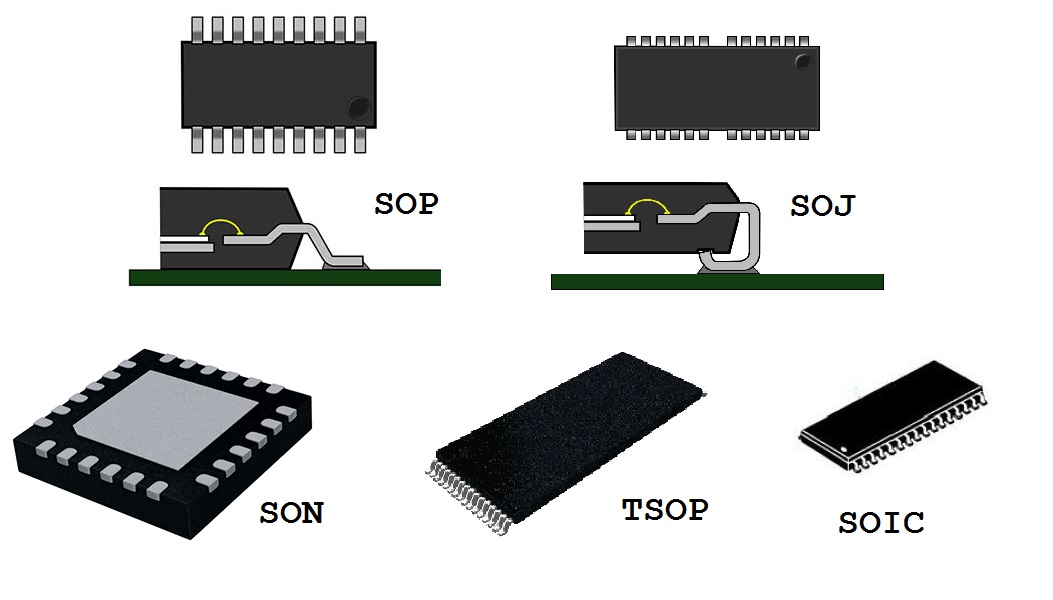
Common SFF Packages and Their Thermal Characteristics
Not all small packages behave the same thermally. Size alone does not tell the full story.
| Package Type | Thermal Strength | Key Limitation |
|---|---|---|
| QFN / DFN | Excellent PCB heat transfer | Heavily board-dependent |
| WLCSP | Minimal thermal mass | Very limited heat paths |
| Micro-BGA | Better spreading | Requires good PCB design |
| Flip-chip | Direct die-to-board path | Assembly complexity |
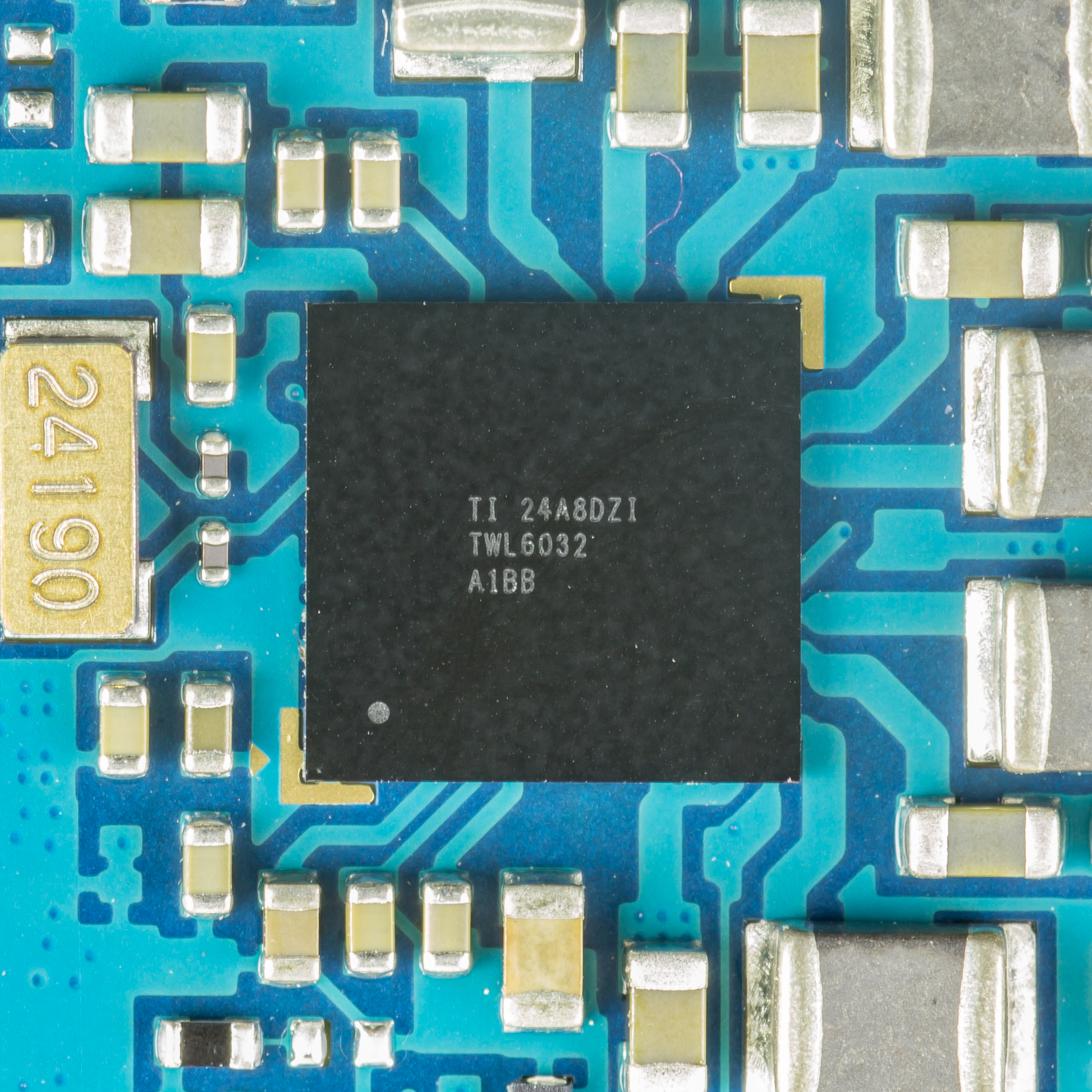
QFN and DFN rely on exposed pads. If the PCB is well designed, they perform well. If not, they fail fast.
WLCSPs are brutally honest. They expose thermal weaknesses instantly. No copper? No escape path.
Micro-BGAs spread heat better but depend on via density and plane design.
Compared to larger packages, SFF devices reach thermal limits sooner—even at lower absolute power.
Package-Level Thermal Design Fundamentals
Inside every SFF package, heat follows one rule:
It takes the path of least resistance.
Primary internal heat paths include:
- Silicon die → die attach
- Die attach → leadframe or bumps
- Leadframe → exposed pad → PCB
Material choices matter:
- Copper leadframes outperform alloy alternatives
- Solder die attach conducts heat better than epoxy
- Mold compound often traps heat instead of spreading it
Internal bottlenecks—thin die attach layers, small contact areas, or low-conductivity mold—can dominate thermal resistance even before heat reaches the board.
The result?
A device that looks safe on paper but overheats in real use.
Key Thermal Metrics Engineers Must Understand
Thermal numbers are often misunderstood. Misused metrics lead to false confidence.
| Metric | What It Really Means | Common Misuse |
|---|---|---|
| Tj (Junction Temp) | Actual silicon temperature | Confused with case temp |
| θJA | System-dependent resistance | Treated as universal |
| θJC | Package internal path | Ignored in SFF analysis |
| Zθ(t) | Time-dependent response | Rarely used, but critical |
θJA is not a constant.
It depends on board size, copper, airflow, and test conditions.
Transient thermal impedance (Zθ(t)) is vital for pulsed loads. Short bursts may be safe—even when steady-state power is not.
Datasheet power ratings assume ideal conditions. Real designs never are.
Time-Dependent Power Dissipation and Real Usage Conditions
Most devices do not dissipate constant power. Reality is messy.
- Bursty workloads
- Sleep and wake cycles
- Communication spikes
- Processor turbo modes
Thermal capacitance acts like a buffer. Short power bursts may not raise junction temperature immediately. But repeated bursts stack heat faster than expected.
Smart designers use:
- Duty-cycle control
- Firmware-based throttling
- Thermal-aware scheduling
Good power management is often cheaper—and more effective—than adding copper.
PCB Design as the Primary Heat Dissipation Path
In SFF packages, the PCB is the heat sink.
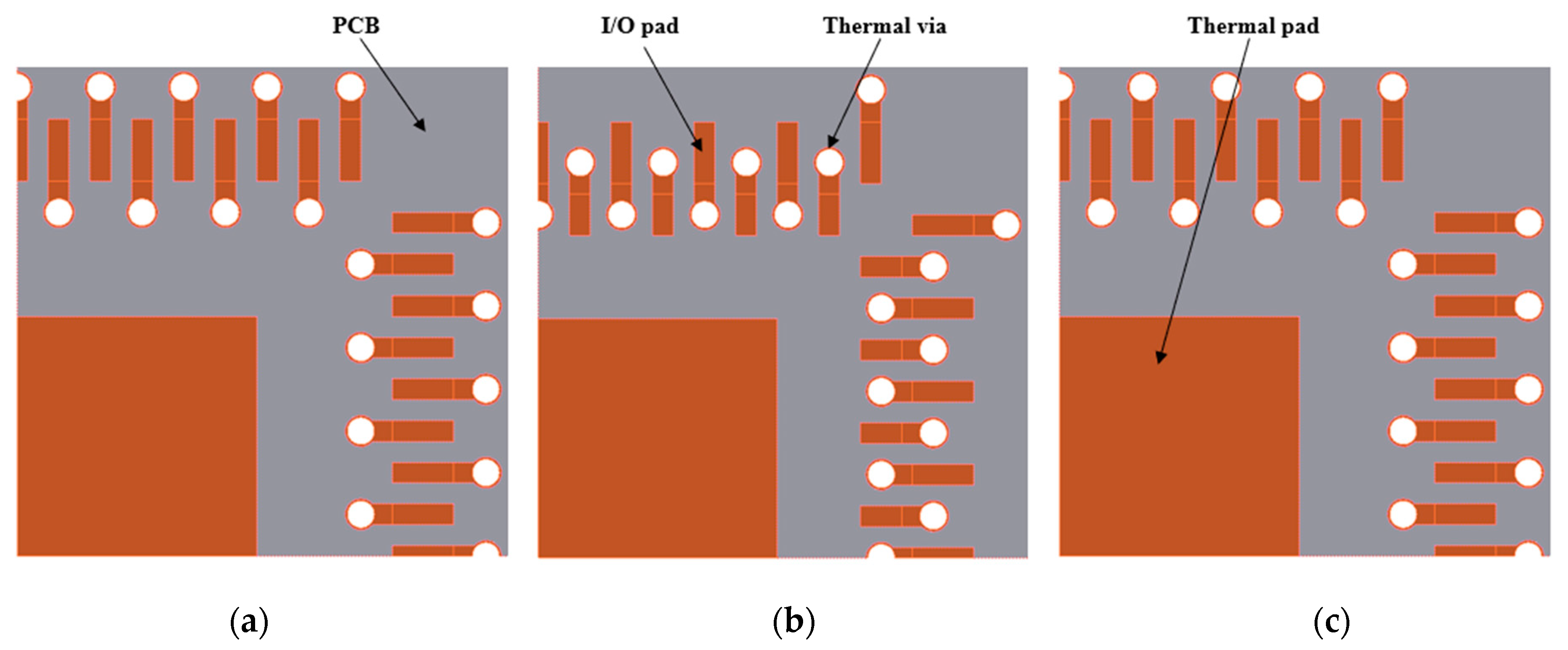
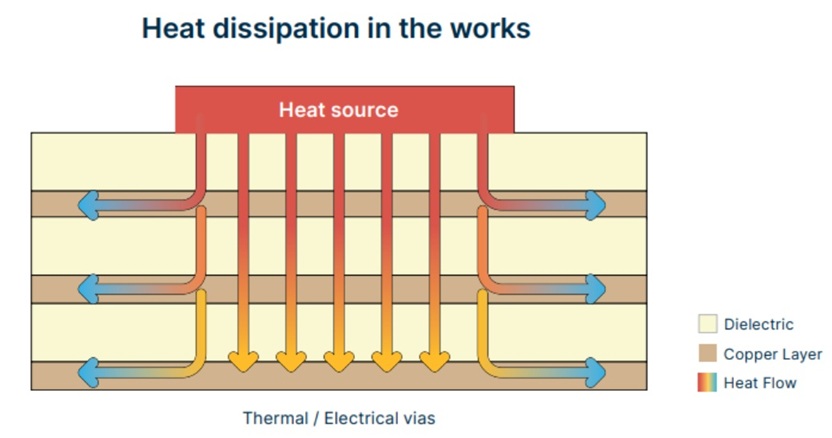
Key PCB factors:
- Copper pour area
- Plane connectivity
- Via count, size, and fill
- Board thickness and copper weight
Best practices:
- Use solid plane connections, not thermal reliefs
- Add dense via arrays under exposed pads
- Tie vias to large internal planes
- Avoid narrow copper neck-downs
Cost trade-off is real. More copper means higher PCB cost. But field failures cost far more.
System-Level Factors Affecting Power Dissipation
Thermal design does not stop at the PCB.
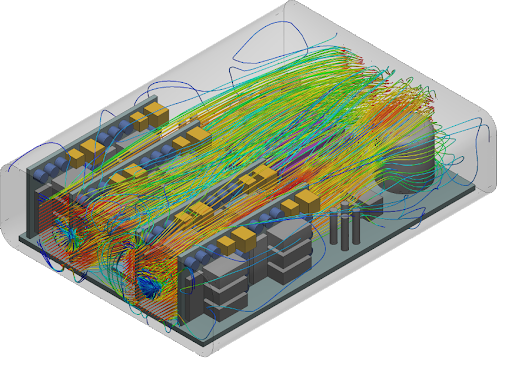
Enclosure, airflow, and placement matter:
- Sealed housings trap heat
- Plastic enclosures insulate
- Nearby hot components compound problems
Even orientation affects convection. A design that passes on the bench may fail inside a compact product.
Mechanical and electrical teams must work together. Late-stage fixes are expensive and often ineffective.
Best Practices for Managing Power Dissipation in SFF Packages


Successful teams follow disciplined habits:
- Analyze early
Thermal issues found late are rarely solvable cheaply. - Design with margin
Derate power. Expect worst-case ambient. - Validate aggressively
Measure junction temperature—not just surface heat. - Iterate intentionally
Improve copper, vias, and placement step by step. - Work with suppliers
Demand realistic thermal data and models.
As reliability experts often say:
“Temperature is the currency of lifetime.”
Spend it wisely.
Final Thoughts
Small form factor packages enable incredible innovation. But they punish thermal mistakes without mercy.
Power dissipation is not a side concern. It is a core design constraint—equal to performance, cost, and size.
Designers who respect heat win longevity, reliability, and customer trust. Those who ignore it learn the lesson later. And painfully.
If you design small, think thermal first.
