
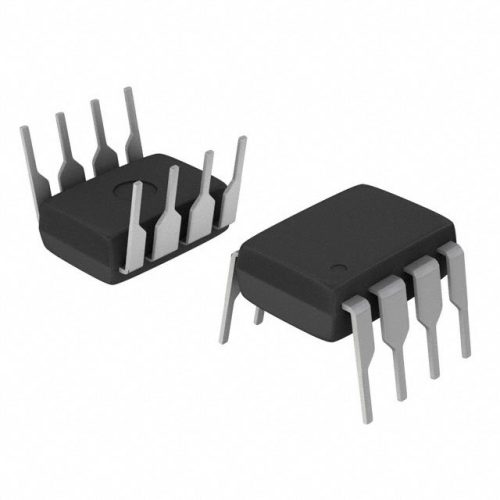

SN74HC164 Serial-In Parallel-Out Shift Register for Embedded and Logic Control
The SN74HC164 from Texas Instruments is an 8-bit serial-in parallel-out shift register designed for high-speed logic control in embedded systems and industrial automation. It allows serial data input through A and B pins and outputs the data in parallel from Q0 to Q7, enabling compact and reliable data handling across various platforms.
This CMOS logic device supports a wide supply voltage range (2V to 6V), making it compatible with both low-voltage and standard 5V logic families. It features asynchronous master reset and positive-edge triggering, suitable for applications such as digital displays, memory address expansion, and LED driver circuits. With IC Manufacturer ensuring quality component sourcing, the SN74HC164 guarantees performance in mission-critical environments.
🔥 Best-Selling Products
Electrical Characteristics and Performance Parameters
| Parameter | Typical Value | Unit |
|---|---|---|
| Function | 8-bit Serial-In Parallel-Out Shift Register | – |
| Supply Voltage Range (Vcc) | 2 ?C 6 | V |
| Input Logic Level High (Vih) | 3.15 (at Vcc = 4.5V) | V |
| Input Logic Level Low (Vil) | 1.35 (at Vcc = 4.5V) | V |
| Propagation Delay (tpd) | 45 | ns |
| Output Drive (Iol/Ioh) | ?4 | mA |
| Package | DIP-14 | – |
Why SN74HC164 Is a Smart Choice
- High-Speed Logic Control: Ensures precise timing for parallel data output from serial input streams, crucial for microcontroller-based systems.
- Voltage Flexibility: Operates across a 2V to 6V supply range for integration into diverse logic systems without additional converters.
- Package Versatility: DIP-14 format is ideal for breadboarding and rapid prototyping in laboratory and industrial environments.
- Strong Output Capability: CMOS output stage can directly drive multiple TTL-level inputs, improving signal chain efficiency.
- Low Static Power: CMOS design offers minimal quiescent current, reducing overall system power draw.
Technical Summary Table
| Feature | Description |
|---|---|
| Device Type | Shift Register |
| Data Type | Serial-In, Parallel-Out |
| Bits | 8 |
| Reset Type | Asynchronous Master Reset |
| Max Clock Frequency | 35 MHz (at Vcc = 6V) |
| Logic Family | HC CMOS |
| Temperature Range | -40??C to +85??C |
Typical Applications
- LED Display and Multiplexing Circuits
- Microcontroller I/O Expansion
- Digital Counter Outputs
- Data Logging and Storage Devices
- Pattern Generators and Timing Control
Frequently Asked Questions (FAQ)
What does the SN74HC164 do?
It converts serial data input into parallel output, storing the bits and shifting them with each clock pulse. This is useful for expanding I/O or controlling devices in sequence.
Can the SN74HC164 operate at 3.3V?
Yes. The SN74HC164 operates reliably across 2V to 6V, making it compatible with both 3.3V and 5V logic systems commonly used in embedded applications.
🌟 Featured Products
-

“Buy MAX9312ECJ+ Precision Voltage Comparator in DIP Package for Reliable Performance”
-
QCC-711-1-MQFN48C-TR-03-1 Bluetooth Audio SoC with MQFN48C Package

-

0339-671-TLM-E Model – High-Performance TLM-E Package for Enhanced Functionality

-
1-1415898-4 Connector Housing, Electrical Wire-to-Board, Receptacle, Packaged
Is this device edge-triggered?
Yes, the register shifts data on the positive clock edge, allowing synchronized data transfer with system clock signals.
Does it require both serial inputs A and B to be used?
No. A and B inputs are logically ORed, so either one or both can be used depending on the desired logic control or signal gating structure.
📩 Contact Us
What makes this better than using discrete logic gates for expansion?
The SN74HC164 offers compact integration, simplified wiring, and faster setup for serial-to-parallel data conversion compared to discrete gate combinations, saving space and design time.
