



How Voltage Regulators Work: A Practical Guide for Engineers and Decision-Makers
“You can’t control what you don’t stabilize.”
This principle, echoed across control theory and power electronics textbooks, explains why voltage regulators sit at the heart of every modern electronic system.
From consumer gadgets to industrial automation and electric vehicles, voltage regulators quietly decide whether a product runs reliably—or fails in the field. This guide explains how voltage regulators work, why they matter, and how engineers and decision-makers can apply them wisely.
Understanding the Role of Voltage Regulators in Modern Electronics
Voltage regulators exist for one simple reason: real-world power is messy.
Batteries sag. Wall adapters fluctuate. Loads change in microseconds. Without regulation, sensitive electronics would behave unpredictably—or stop working entirely.
Why stable voltage is critical
Digital ICs demand tight voltage limits. Too low, and logic fails. Too high, and silicon degrades. Analog circuits are even less forgiving—noise and ripple directly corrupt signals.
Engineering and business impact
Good regulation improves:
- Product reliability
- Certification success
- Time-to-market
- Warranty cost
Poor regulation increases field failures and erodes brand trust.
Where regulators are used
You’ll find voltage regulators in:
- Smartphones and laptops
- Industrial PLCs
- Medical devices
- Automotive ECUs
- IoT sensors and wearables
In short, if it has electronics, it has voltage regulation.
What Is a Voltage Regulator?
A voltage regulator is an electronic circuit that maintains a constant output voltage, regardless of input changes or load variation.
Core function
Its job is to compare the output voltage to a known reference and correct any deviation—continuously.
Variables under control
A regulator manages:
- Input voltage variation
- Load current changes
- Temperature effects
Real-world examples
- A phone charger converting unstable adapter voltage into safe 5 V
- An automotive regulator protecting ECUs from load dumps
- An industrial controller feeding precise voltage to sensors
Why Voltage Regulation Matters
Voltage regulation is not just an electrical concern—it’s a strategic one.
Benefits for engineers
- Predictable circuit behavior
- Reduced design rework
- Improved noise performance
Reliability and compliance
Stable power directly supports:
- EMC compliance
- Functional safety
- Long-term reliability
Cost and lifecycle impact
Efficient regulation reduces:
- Thermal stress
- Heatsink size
- Battery drain
In many products, power design defines success or failure.
The Basic Working Principle of Voltage Regulators
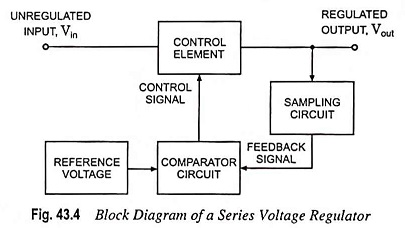
At the heart of every regulator is closed-loop feedback control.
How feedback works
- Output voltage is sensed
- Compared to a reference voltage
- Any error is amplified
- The regulator adjusts its control element
This loop runs constantly—often millions of times per second.
Key internal elements
- Reference voltage: the target
- Error amplifier: measures deviation
- Control action: corrects the output
Response to change
When load current suddenly increases, output voltage dips. The regulator detects this instantly and compensates—restoring stability.
Internal Architecture of Voltage Regulators
Although implementations differ, most regulators share the same internal blocks.
Core building blocks
- Voltage reference
- Error amplifier
- Pass element
- Feedback network
Series vs shunt regulation
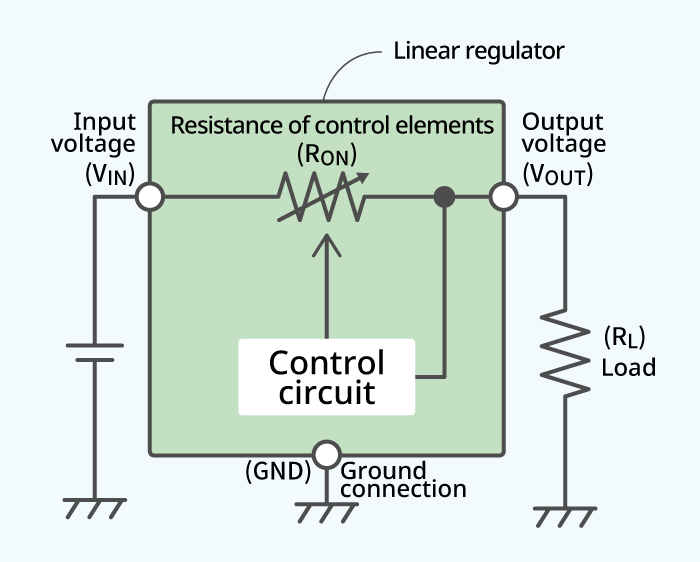
- Series regulators control current in line with the load
- Shunt regulators divert excess current away
Series regulation dominates modern designs due to efficiency.
Pass transistor choice
- BJTs: strong gain, higher dropout
- MOSFETs: low dropout, high efficiency
MOSFET-based designs enable modern LDOs and switching regulators.
Linear vs Switching Voltage Regulators: How They Work Differently
This is the most important distinction in power design.
Linear regulators
Linear regulators drop excess voltage as heat.
Simple. Quiet. Inefficient.
Efficiency ≈ Vout / Vin
Great for low-noise, low-power applications.
Switching regulators
Switching regulators move energy using inductors and capacitors.
Efficient. Complex. Noisy.
Efficiency often exceeds 90%, even with large voltage differences.
Practical implications
- Linear: small, simple, low EMI
- Switching: efficient, scalable, thermally friendly
Main Types of Voltage Regulators
Different applications demand different regulator types.
Linear regulators
- Simple design
- Low output noise
- Poor efficiency at high voltage drop
LDO (Low Dropout) regulators
- Operate with minimal input-output difference
- Ideal for battery-powered devices
Switching regulators
- Buck (step-down)
- Boost (step-up)
- Buck-boost / SEPIC
Each topology serves a clear electrical purpose.
Efficiency, Thermal Behavior, and Protection Mechanisms
Power loss always becomes heat. Managing it is non-negotiable.
Efficiency basics
Efficiency = Output Power / Input Power
Linear regulators waste power as heat. Switching regulators waste it in switching and conduction losses.
Thermal behavior
Key concepts:
- Junction temperature
- Thermal resistance
- Derating curves
PCB copper area often matters more than heatsinks.
Built-in protection
Modern regulators include:
- Overcurrent protection
- Thermal shutdown
- Undervoltage lockout
- Reverse current protection
These features prevent catastrophic failure.
How to Choose the Right Voltage Regulator
Choosing a regulator is both technical and strategic.
Key technical criteria
- Input voltage range
- Output voltage accuracy
- Load current
- Efficiency target
- Noise tolerance
Supply chain realities
Availability, second sourcing, and lifecycle status matter—especially for long-lived products.
Decision-maker perspective
The best regulator balances:
- Performance
- Cost
- Reliability
- Risk
Overdesign wastes money. Underdesign destroys products.
Summary: Applying Voltage Regulators Effectively
Voltage regulators are not optional components. They are system enablers.
Remember this:
- Stable voltage equals stable systems
- Linear regulators favor simplicity and silence
- Switching regulators favor efficiency and power density
- Thermal and protection design is as critical as electrical design
When chosen wisely, voltage regulators disappear into the background—doing their job quietly, efficiently, and reliably.
And in engineering, that’s the highest compliment of all.
