

MT48LC16 SDRAM: What Engineers, Buyers, and Decision-Makers Need to Know Before Sourcing
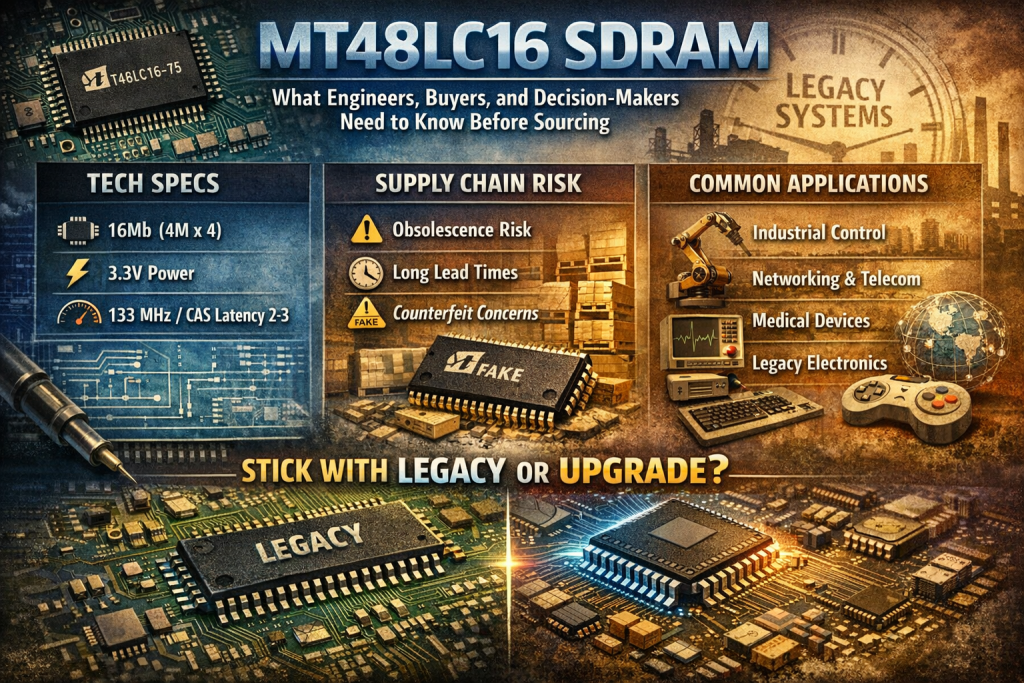
Sourcing legacy memory is never just a technical decision. It is a strategic one.
The MT48LC16 SDRAM has powered embedded systems, industrial controllers, and networking platforms for decades. It is mature. Proven. Stable. But also aging.
For engineers, it raises questions about integration and timing.
For buyers, it creates supply-chain risk.
For executives, it impacts product longevity and redesign cost.
This guide cuts through confusion. Clear language. Deep detail. Practical insight.
Everything you need—before you commit.
What Is MT48LC16 SDRAM?
The MT48LC16 is a synchronous dynamic random-access memory (SDRAM) designed for 3.3-volt systems. It belongs to the classic SDR SDRAM generation defined by early JEDEC standards.
It is most commonly configured as 4M × 4 bits, delivering 16 megabits (16Mb) of total storage. That density still causes confusion today—often mistaken for 16MB or even 64Mb.
The part was developed and manufactured by Micron Technology, a global leader in DRAM innovation. Micron’s SDRAM portfolio from the late 1990s and early 2000s set the baseline for many long-life designs still shipping today.
Why it still matters:
“If it isn’t broken, don’t fix it.” — Engineering proverb widely cited in industrial design
Many legacy platforms were validated, certified, and qualified around this exact memory device. Changing it can mean re-testing, re-certification, and real cost.
Memory Organization and Density Clarification
This is where most sourcing mistakes begin.
Exact Density Explained
- Total density: 16 megabits (Mb)
- Typical configuration: 4M words × 4 bits
- Total bytes: 2 megabytes (MB)
Not 16MB. Not 64Mb. Precision matters.
Internal Architecture
The MT48LC16 uses:
- 4 internal memory banks
- Multiplexed row and column addressing
- Shared data bus with burst access
This banked architecture allows interleaving, improving throughput when used correctly by the controller.
Refresh Mechanism
Like all SDRAM:
- Requires periodic refresh
- Supports auto-refresh and self-refresh
- Refresh timing is controller-managed
Miss refresh windows, and data fades. Physics always wins.
Key Technical Characteristics and Performance
Short sentences. Clear facts.
Electrical and Interface Overview
- Memory type: SDR SDRAM
- Voltage: 3.3V ±0.3V
- Interface: Single-ended TTL/CMOS compatible
Speed and Timing
Common speed grades include:
- -75 (133 MHz)
- -10 (100 MHz)
Key timing parameters:
- CAS latency: 2 or 3 clocks
- tRCD, tRP, tRAS: Defined by speed grade
- Burst lengths: 1, 2, 4, 8, or full page
Reality check:
Actual system speed depends more on controller efficiency than raw SDRAM frequency.
Power Consumption and Thermal Behavior
Power is rarely the headline—but often the constraint.
Power States
- Active: Highest consumption during read/write
- Standby: Reduced power when clocked but idle
- Self-refresh: Minimal power, clock stopped
For embedded systems, self-refresh can significantly reduce average power—especially in duty-cycled designs.
Thermal Limits
- Commercial grade: 0°C to +70°C
- Industrial grade: –40°C to +85°C
Thermal derating applies at high clock speeds and poor airflow. Heat shortens life. Always has.
Applications and Use Cases
The MT48LC16 survives because it fits where newer memory often does not.
Common Deployments
- Industrial automation controllers
- Networking and telecom modules
- Medical devices with frozen BOMs
- Consumer electronics using legacy chipsets
In regulated industries, redesign is expensive. Memory changes trigger audits, not applause.
Engineering Integration and Design Considerations
From a layout perspective, SDRAM is unforgiving.
Pinout and Signals
- Multiplexed address bus
- Dedicated clock (CLK)
- Data strobes aligned to clock edge
PCB Best Practices
- Short, matched data traces
- Solid ground reference
- Close-coupled decoupling capacitors
- Controlled impedance where possible
Common Mistakes
- Ignoring clock skew
- Poor termination
- Inadequate power filtering
“Most memory failures are not memory failures.” — Common hardware debugging maxim
They are layout problems.
Initialization and Controller Requirements
SDRAM does nothing until properly trained.
Power-Up Sequence
- Apply stable power
- Wait minimum power-on delay
- Issue precharge-all
- Perform auto-refresh cycles
- Load mode register
Miss a step, and behavior becomes unpredictable.
Controller Compatibility
Ensure your controller supports:
- Correct CAS latency
- Required refresh rate
- Burst and addressing modes
Many failures blamed on “bad memory” are simply incorrect initialization code.
Purchasing, Lifecycle, and Supply-Chain Risk
This is where strategy matters more than specs.
Lifecycle Reality
The MT48LC16 is mature. In some cases, NRND or EOL-adjacent depending on grade and package.
Risks
- Long lead times
- Allocation during shortages
- Counterfeit components
Mitigation Strategies
- Buy from authorized distributors
- Lock last-time-buy quantities
- Qualify alternates early
- Maintain buffer inventory
Buyers who plan late pay more. Always.
Should You Still Use MT48LC16 Today?
The answer is not emotional. It is situational.
Use It When
- You have a qualified legacy design
- Redesign cost outweighs sourcing risk
- Volume is predictable and controlled
Move On When
- You face new design starts
- Long-term supply is uncertain
- Performance or power is limiting growth
Strategic advice:
For existing products—manage risk.
For new designs—modernize.
Memory is foundational. Choose wisely.
Final Thought
The MT48LC16 is not obsolete—it is seasoned.
But time never stops.
Those who understand both engineering detail and supply-chain reality will make the best decision—before constraints force their hand.
If you want help comparing drop-in alternatives, lifecycle strategies, or redesign paths, say the word.
