


AD8232 Arduino / ESP32 Heart Rate Monitor Project: Complete Guide for ECG & IoT Applications
Introduction
Electrocardiogram (ECG) projects sit at the intersection of electronics, biology, and data science. Simple in concept. Powerful in impact. The AD8232 heart rate monitor project with Arduino or ESP32 is one of the most practical ways to learn real-world biosignal acquisition.
This guide is written for students, makers, engineers, and IoT developers who want depth—not shortcuts. You will understand why things work, not just how to wire them.
“An experiment is a question which science poses to Nature.” — Max Planck
Important disclaimer:
This project is educational and experimental only. It is not a medical device and must never be used for diagnosis or treatment.
Understanding ECG vs Heart Rate (Foundations)
Before touching hardware, clarity matters.
ECG Is a Signal, Heart Rate Is a Metric

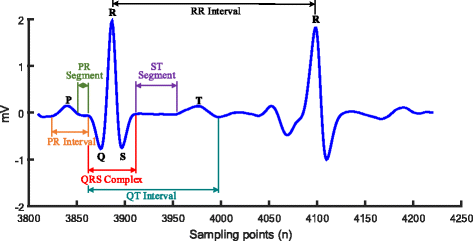
An ECG is a raw electrical waveform generated by the heart’s depolarization.
Heart rate (BPM) is a calculated value derived from that waveform.
| Term | What It Is | What It Shows |
|---|---|---|
| ECG | Continuous analog signal | P, QRS, T waves |
| Heart Rate | Numeric result | Beats per minute |
Why AD8232 Does Not Output BPM
The AD8232 outputs analog ECG voltage, not heart rate.
You must sample, filter, and detect R-peaks in software.
How BPM Is Calculated
- Detect R-peaks
- Measure time between peaks (R–R interval)
- Convert to BPM
Simple math. Complex execution.
Understanding the AD8232 ECG Front-End
What the AD8232 Is
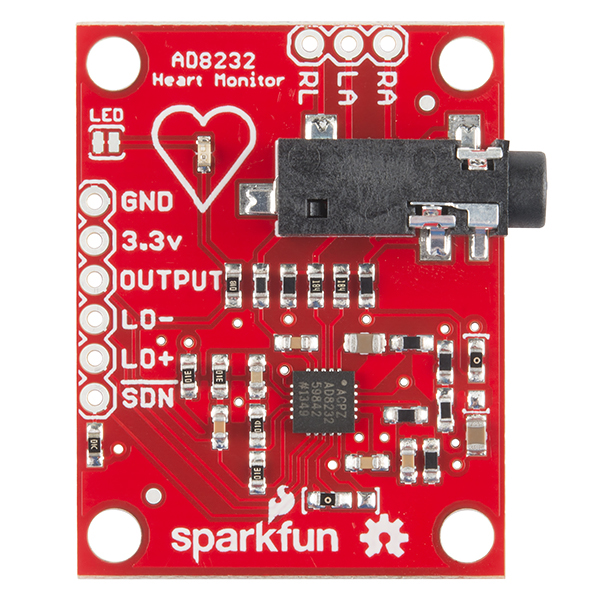
The AD8232 is an integrated ECG front-end IC designed by Analog Devices.
It amplifies microvolt-level heart signals while rejecting noise.
Internal Functional Blocks
- Instrumentation amplifier
- High-pass and low-pass filters
- Right-leg drive (RLD) for common-mode rejection
- Lead-off detection
Strengths and Limits
Strengths:
- Low power
- Clean ECG output
- Ideal for learning and prototyping
Limitations:
- Single-lead only
- No isolation
- Not medical-grade
AD8232 vs Other Heart Rate & ECG Sensors

ECG vs Optical Sensors (PPG)
PPG sensors (like MAX30102) use light. ECG uses electricity.
| Feature | AD8232 (ECG) | MAX30102 (PPG) |
|---|---|---|
| Measures | Electrical activity | Blood volume |
| Motion sensitivity | Medium | High |
| ECG waveform | Yes | No |
| Heart rhythm analysis | Yes | Limited |
Rule of thumb:
If you want waveform analysis, choose ECG.
If you want fitness tracking, choose PPG.
Why AD8232 Works Well with Arduino & ESP32
Rapid Prototyping Advantage
Platforms like Arduino and Espressif Systems reduce friction.
Short wires. Clear libraries. Fast feedback.
Arduino vs ESP32 (At a Glance)
| Feature | Arduino Uno | ESP32 |
|---|---|---|
| ADC Resolution | 10-bit | 12-bit |
| Max Sampling | Limited | Higher |
| Wireless | No | Wi-Fi + BLE |
| IoT Ready | ❌ | ✅ |
ESP32 wins for IoT.
Arduino wins for simplicity.
Hardware Design & System Architecture


Core Components
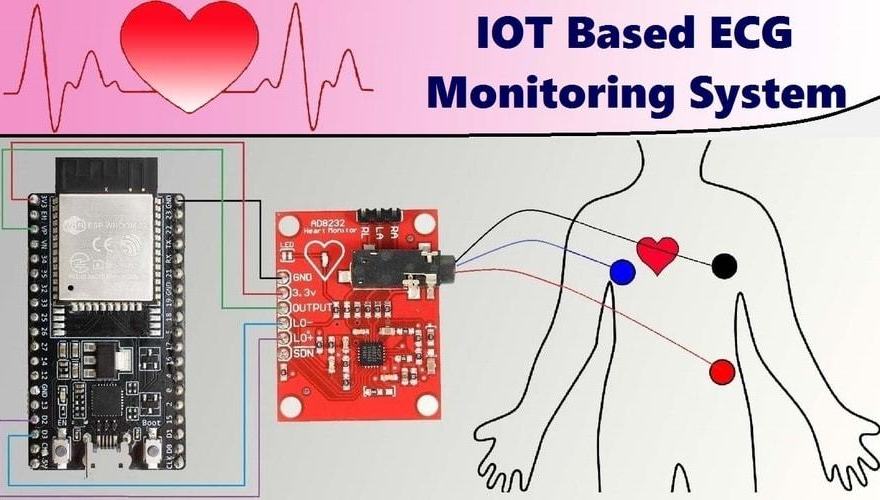
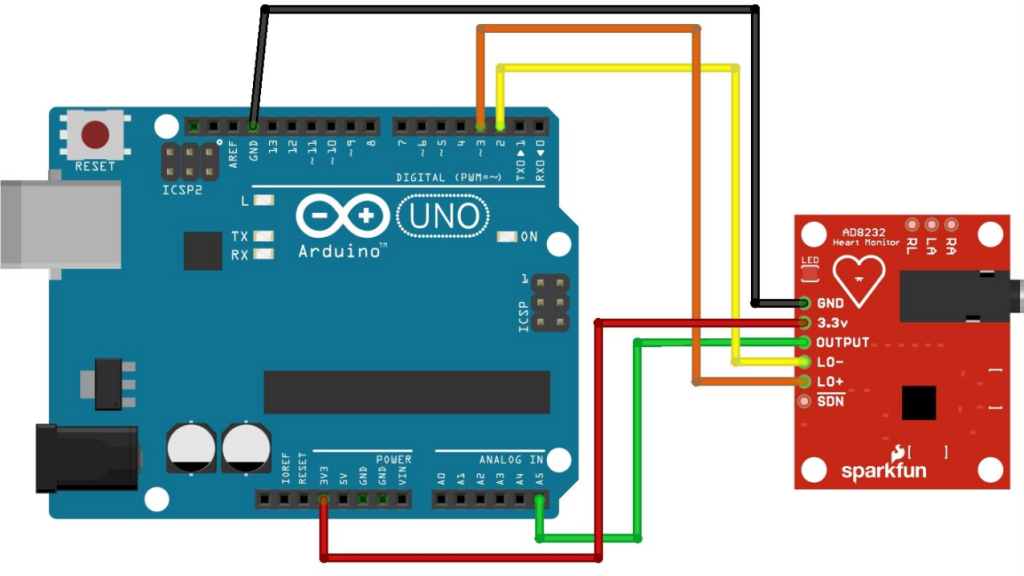
- AD8232 module
- Arduino or ESP32
- Disposable ECG electrodes
- Battery power (recommended)
Electrode Placement (3-Lead)
- RA: Right arm
- LA: Left arm
- RL: Reference (right leg)
Skin prep matters. Clean skin. Firm contact.
Lead-Off Detection
LO+ and LO– pins indicate electrode disconnection.
Ignore them—and you will chase ghosts.
Sampling Rate, Timing & Data Accuracy
Recommended Sampling Rate
For ECG:
| Use Case | Sampling Rate |
|---|---|
| Basic visualization | 250 Hz |
| Accurate HRV | 500 Hz |
Timing Is Everything
delay()introduces jitter- Timer interrupts are cleaner
- ESP32 hardware timers are superior
Bad timing equals bad BPM.
ECG Signal Processing & Heart Rate Calculation


Digital Preprocessing
Typical steps:
- DC offset removal
- Band-pass filtering (0.5–40 Hz)
- Signal normalization
R-Peak Detection
Two common methods:
- Fixed threshold (simple, fragile)
- Pan–Tompkins (robust, complex)
BPM Formula
BPM = 60 / (R–R interval in seconds)
Motion artifacts are the enemy. Algorithms must adapt.
IoT, Data Visualization & Cloud Integration
Real-Time Visualization
- Arduino Serial Plotter
- Processing / Python
- Web dashboards
Cloud & Mobile Apps
ESP32 enables:
- MQTT brokers
- Firebase
- ThingsBoard
- BLE mobile apps
Security Matters
ECG data is biometric data.
Encrypt. Authenticate. Minimize exposure.
“With great data comes great responsibility.”
Conclusion: Key Takeaways
The AD8232 is not just a sensor.
It is a teacher.
You learn:
- Analog signal design
- Sampling theory
- Digital filtering
- Embedded timing
- IoT architecture
Best practices summary:
- Use battery power only
- Sample at ≥250 Hz
- Avoid
delay() - Validate signals before BPM
- Never treat this as a medical device
From classroom demos to IoT dashboards, this project scales with your skill.
Master the basics—and the waveform will tell you everything.
If you want, I can next:
- Provide tested Arduino & ESP32 code
- Design a clean ECG filtering pipeline
- Help you build a real-time IoT dashboard
Just say the word.
