
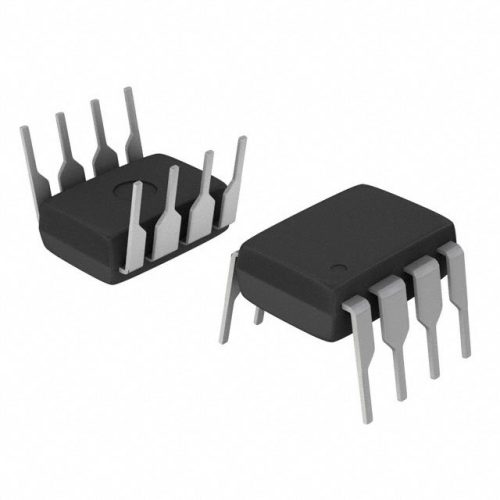
MSP430G2231IN14 Overview
The MSP430G2231IN14 is a low-power, 16-bit microcontroller optimized for battery-powered and cost-sensitive embedded systems. It combines a ultra-low-power MSP430 CPU with on-chip nonvolatile memory and basic peripherals for control, timing, and serial interfacing. With a compact 14-pin package and wide supply range, it is suited for compact sensor nodes, handheld instruments, and power-conscious industrial controls. For sourcing and further component options visit IC Manufacturer.
MSP430G2231IN14 Technical Specifications
| Core | 16-bit MSP430 RISC CPU |
| Maximum CPU Clock | Up to 16 MHz (DCO) |
| On-chip Flash | 2 KB nonvolatile flash memory |
| RAM | 128 bytes SRAM |
| Supply Voltage | 1.8 V to 3.6 V |
| Operating Temperature | -40 ??C to +85 ??C |
| Package | PDIP-14 (14-pin through-hole) |
| Digital I/O | Multiple GPIO pins accessible on 14-pin package |
| Timers | Timer_A with capture/compare functionality |
| Serial Interface | USI-based serial peripheral for SPI/I2C-style communication |
| Low-Power Modes | Multiple LPMs for aggressive power savings |
| Debug/Programming | On-chip support for Spy-Bi-Wire (SBW) programming and debugging |
MSP430G2231IN14 Key Features
- Single 16-bit MSP430 core delivers compact control and faster integer math compared with 8-bit microcontrollers.
- Integrated 2 KB flash and 128 B RAM reduce external memory needs, cutting BOM and board area.
- Ultra-low-power modes and a DCO allow multi-year battery life in intermittent duty-cycle applications.
- Timer_A and capture/compare hardware give precise timing and PWM without continuous CPU intervention.
- USI serial interface supports both simple SPI and basic I2C-like communications, easing sensor and peripheral integration.
- PDIP-14 package supports easy prototyping and through-hole production compared with surface-mount-only devices.
Typical Applications
- Battery-powered sensor nodes requiring less than a few kilobytes of code memory and aggressive low-power standby between events.
- Handheld instruments where small firmware, accurate timing, and multi-year battery life are critical for measured portability.
- Basic industrial control tasks that need a compact MCU with reliable watchdog, timer capture, and simple serial peripheral support.
- Consumer products such as appliance controllers and remote controls that benefit from low system cost and through-hole assembly options.
MSP430G2231IN14 Advantages vs Typical Alternatives
The device combines a 16-bit core with 2 KB flash and ultra-low-power operation, offering higher computational density and lower sleep currents than many 8-bit alternatives. Its integrated Timer_A and USI reduce the need for external logic and off-chip peripherals, lowering system cost. The PDIP-14 package also makes it easier to prototype and repair compared with smaller, surface-mount-only parts. Overall, it provides a compact, energy-efficient solution for simple embedded control where 2 KB code space and minimal RAM suffice.
🔥 Best-Selling Products
-
Texas Instruments BQ24075 Linear Battery Charger IC – 5mm x 4mm QFN Package
-
Texas Instruments INA219 Current Sensor Module – SOIC Package, Precision Monitoring
-
Texas Instruments LM4041 Precision Voltage Reference – SOT-23 Package
-
Texas Instruments OPA2134 Audio Op Amp – Dual, High-Performance, SOIC-8 Package
MSP430G2231IN14 Brand Info
The MSP430G2231IN14 is part of Texas Instruments’ MSP430 family of ultra-low-power microcontrollers. TI positions this product for cost-sensitive, low-power applications that require reliable timing and modest memory. The MSP430 lineup emphasizes long battery life, compact code size, and straightforward development using TI toolchains and on-chip debug support.
FAQ
What is the supply voltage range?
This MCU operates over a nominal supply range of 1.8 volts to 3.6 volts, enabling use with common single-cell lithium and multiple alkaline battery chemistries.
🌟 Featured Products
-

“Buy MAX9312ECJ+ Precision Voltage Comparator in DIP Package for Reliable Performance”
-
QCC-711-1-MQFN48C-TR-03-1 Bluetooth Audio SoC with MQFN48C Package
-

0339-671-TLM-E Model – High-Performance TLM-E Package for Enhanced Functionality
-
1-1415898-4 Connector Housing, Electrical Wire-to-Board, Receptacle, Packaged
How much on-chip flash is available?
The device provides 2 kilobytes of on-chip flash memory for code and nonvolatile storage, sufficient for compact embedded firmware and small lookup tables.
What debug and programming options exist?
On-chip support for Spy-Bi-Wire (SBW) allows in-circuit programming and debugging with TI-compatible programmers and debuggers, simplifying development and production programming.
📩 Contact Us
Does it support low-power standby?
Yes, multiple low-power modes are provided to minimize current draw while retaining RAM or wake-up sources, suited for long-lived battery applications.
Which serial interfaces are available?
The device features a USI-based serial peripheral capable of SPI-style operation and simple I2C-like protocols, enabling interfaces to sensors and serial peripherals without dedicated UART hardware.